Deeds and papers of the Hartfield estate
DD/HF/2/14DD/HF/2/14 — imported from CALM export, unchanged
File
Open — access conditions carried over from source record
CALM migration § 01
CALM is reaching end-of-life, and a generation of UK archives is deciding what comes next. This page sets out where Archivers.ai fits — honestly, including what we don’t do — and the migration workflow that keeps your reference numbers intact and your data portable.
The cliff § 02
For twenty years, CALM has been where UK archival description lives. That era is ending — on the vendor’s timetable, not yours.
Axiell has announced CALM’s end-of-life; dates cited across the sector cluster around the end of 2027, though the timeline that matters is the one in your own contract. There is an announced successor platform, and for some services moving to it will be the right call. But many CALM users are treating the deadline as a moment to ask a bigger question: after two decades, is a like-for-like collections management system actually what the service needs next — or is it cataloguing capacity and public access?
“There’s hundreds of us that are now trying to get to another platform.”
— senior archivist, county heritage service
Whichever way you go, the migration itself is the risk: decades of accumulated description, local field conventions, and reference schemes that must survive the move intact. That’s the problem this page is about.
Where we sit § 03
Archivers.ai is not a like-for-like CALM replacement — and doesn’t try to be.
At one end sits a full collections management system: powerful, structured, and heavy. At the other sits the spreadsheet: flexible, familiar, and flat — no standards model, no search, no public face. Most of the sector has spent years bouncing between the two.
Archivers.ai sits in the middle. It is an AI-assisted cataloguing and access platform: it turns uncatalogued and part-catalogued material into ISAD(G)-aligned, archivist-reviewed records, makes them searchable, publishes them through a public portal, and exports them in open standards formats — EAD3, Dublin Core, CSV — so your data is never stranded again. If you later adopt a successor CMS, our exports are designed to move with you. The migration you make now shouldn’t be the last one you’re allowed.
“There’s either you use something like CALM or you use Excel. There’s nothing really in the middle — and I think this sits in the middle quite nicely.”
— a county archivist, on where Archivers.ai fits
The migration path § 04
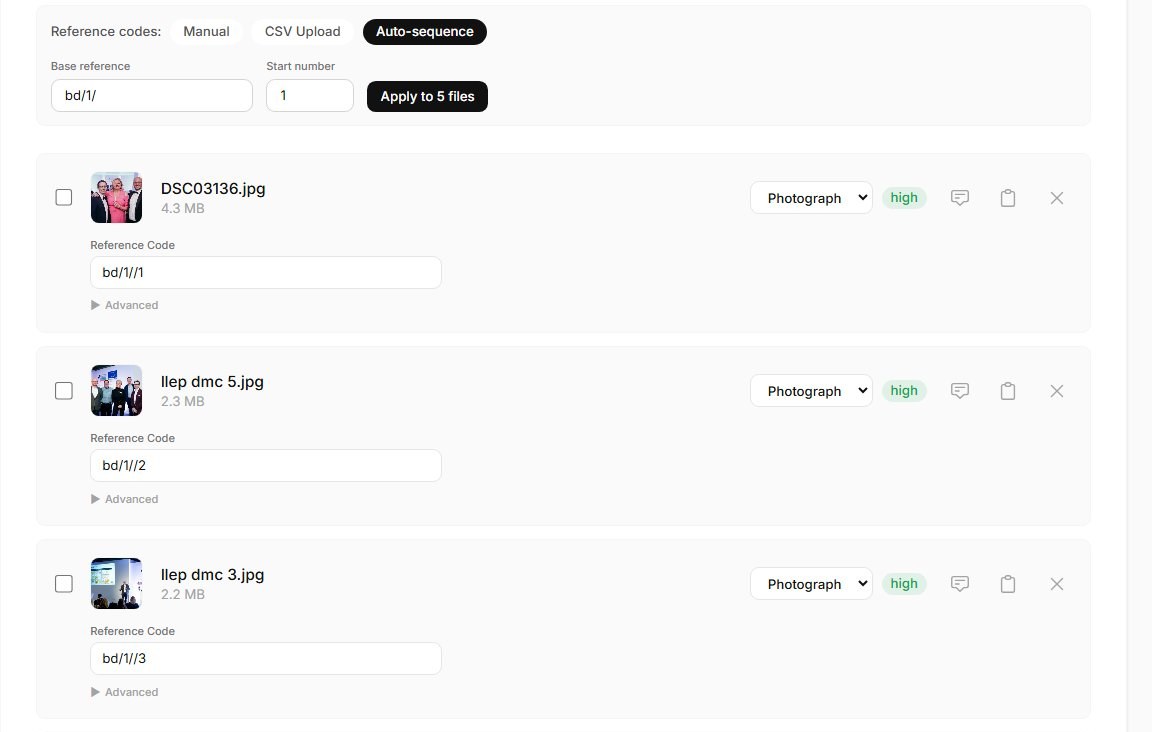
To be clear before anything else: there is no direct CALM integration, and we won’t claim one. The migration workflow runs on CALM’s own CSV and EAD exports — mapped, cleaned and reviewed with you during onboarding.
Use CALM’s own CSV or EAD export. We’ll tell you exactly which fields to include — and how to run it if the in-house knowledge has been lost.
CALM exports carry system codes and internal fields alongside your descriptions. During onboarding we agree the mapping, filter the noise, and you review a sample import first.
The number is king. Reference numbers import exactly as exported, stay visible on every record, and are never regenerated behind your back.
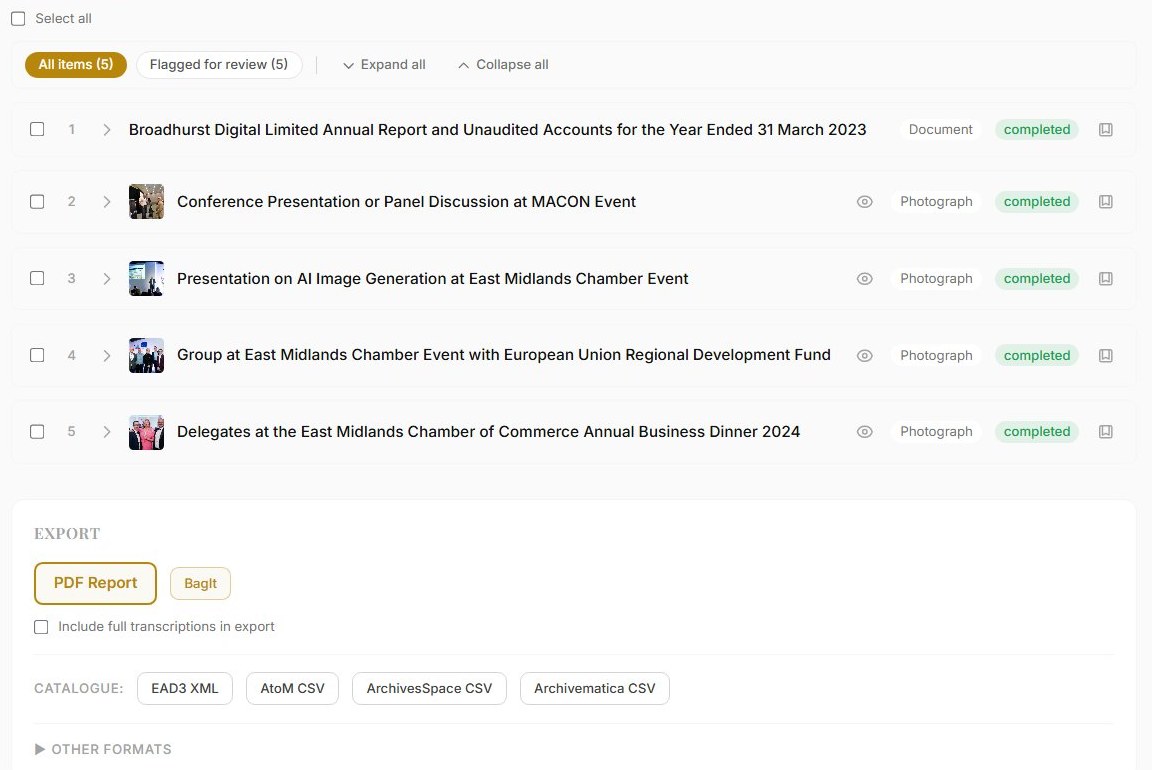
Your records leave as Dublin Core, CSV, EAD3 — or CALM CSV with a former-reference concordance — whenever you want them: into a successor system, an aggregator, or long-term preservation.
DD/HF/2/14 — imported from CALM export, unchanged
File
Open — access conditions carried over from source record
A representative migrated record. Every imported record keeps its reference number and is reviewed by an archivist before it enters the catalogue.
What carries over § 05
A migration is only as good as its field mapping. Here is how the main CALM export fields are treated — agreed with you, per instance, during onboarding.
| In your CALM export | In Archivers.ai | Notes |
|---|---|---|
| RefNo / AltRefNo | Reference number — preserved exactly, always visible | Never regenerated; sequenced sub-numbering available for new material |
| Title, Description, Dates, Extent | ISAD(G)-aligned descriptive fields | Mapped field-by-field; you review a sample import before committing |
| Level (fonds / series / file / item) | Hierarchical levels | Fully supported — fonds, sub-fonds, series and sub-series, plus collective-level description at every level and nested multilevel EAD3 export |
| Access conditions & closure status | Access conditions; restricted records stay restricted | Nothing becomes public without an archivist’s decision |
| System codes & internal fields (“the gunk”) | Filtered during onboarding | Reviewed with you before anything is discarded |
| Everything, outbound | Dublin Core · CSV · EAD3 | Open formats only — your next migration is yours to choose |
Inbound, this is a migration workflow via CSV and EAD export through an auto-mapping wizard — not a live CALM integration, and not yet a validated end-to-end CALM migration. Outbound, CALM CSV export (with former-reference concordance) is shipped and ready to use today. We publish that distinction deliberately: it’s the honest description of how the move works, and it’s reviewed at every step. See export formats for annotated outbound examples.
Are you on CALM? § 06
Not everyone on CALM is in the same position. Find yours.
Your end-of-life date is set and you’re actively planning the move. Book a migration-scoped Backlog Sprint: bring a CALM export sample, and we’ll map it with you.
Scope a migration Sprint → Route iiThe move is coming, and a funded project — NLHF or a cataloguing grant — could carry it. See how AI-assisted cataloguing fits a grant budget as a line item.
See the funding route → Route iiiHappy with your CMS, whatever it is? Then your question isn’t the database — it’s the backlog. Archivers.ai adds the cataloguing layer alongside the system you keep.
See how we fit your stack →De-risk the move § 07
The lowest-risk way to evaluate a migration is to run a small one.
The Backlog Sprint is our fixed-scope, 30-day pilot, scoped on a call. For CALM services we run it as a migration rehearsal: you bring a CALM export from one collection — gunk and all — and we map it, clean it, and import it together. Your team reviews every record, checks that every reference number survived, and exports the result back out as Dublin Core, CSV, EAD3, or CALM CSV to prove the round trip.
You end the Sprint with a reviewed sample of your own catalogue in the platform, a documented field mapping for your instance, and hard evidence for the committee — not a slide deck. The archivist decides, at every step, what’s good enough to keep.
Common questions § 08
Is Archivers.ai a direct replacement for CALM?
Not like-for-like, and we won’t pretend otherwise. CALM is a collections management system; Archivers.ai is an AI-assisted cataloguing and access platform that sits between a full CMS and a spreadsheet. Many services leaving CALM find that what they actually need next is cataloguing capacity, searchable access, and standards-based exports that keep their data portable — which is exactly what Archivers.ai provides. Whatever successor system you choose, our exports (EAD3, Dublin Core, CSV) are designed to move with you.
Does Archivers.ai have a direct CALM integration?
No direct, live integration — and we would rather say that plainly than over-claim. Inbound, the migration workflow runs on CALM’s own CSV and EAD exports, mapped with an auto-mapping wizard during institutional onboarding; that mapping is heuristic CALM-header detection, not yet a validated canonical CALM field mapping, so you always review a sample import before anything is committed. Outbound, we go further: alongside Dublin Core, CSV and EAD3, Archivers.ai generates a CALM CSV export with a former-reference concordance, so records can move back into a CALM instance with their legacy reference intact. See the CALM CSV export example.
Will our reference numbers survive the migration?
Yes. Reference numbers are treated as authoritative identifiers, not as regenerable data. They are imported exactly as exported, stay visible on every record, and are carried through every outbound export. For new material, Archivers.ai supports sequenced sub-numbering within your existing scheme — and an archivist reviews every record before it enters the catalogue.
CALM exports are messy — how do you handle that?
It’s a known problem: CALM exports carry system-generated codes and internal fields alongside the descriptive data you actually want. One county archivist described it to us as “a lot of gunk — random codes, system fields we don’t quite understand”. Cleaning that up is a standard part of institutional onboarding — we agree the field mapping with you, filter the system fields, and you review a sample import before anything is committed. Nothing is discarded without your sign-off.
When does CALM reach end-of-life?
Axiell has announced CALM’s end-of-life, with dates cited across the sector clustering around the end of 2027 — though the timeline that matters is the one in your own contract and support arrangements. Whatever your exact date, migrations of decades-old catalogues take longer than anyone expects, so the planning window is now.
What about the announced successor platform?
Axiell has announced a successor platform for CALM users, and for some services it will be the right destination — we’re not here to talk anyone out of it. Our position is simpler: whichever system you choose, your description should be portable, your reference numbers should survive, and your backlog still needs cataloguing capacity that no CMS provides on its own. Archivers.ai works alongside whatever you land on.
Bring a CALM export sample to a migration-scoped Backlog Sprint, or join the early-access waitlist and tell us you’re on CALM — migrating services are exactly who we want in the room.
CSV / EAD in via mapping wizard · Dublin Core / CSV / EAD3 / CALM CSV out · reference numbers preserved · the archivist decides