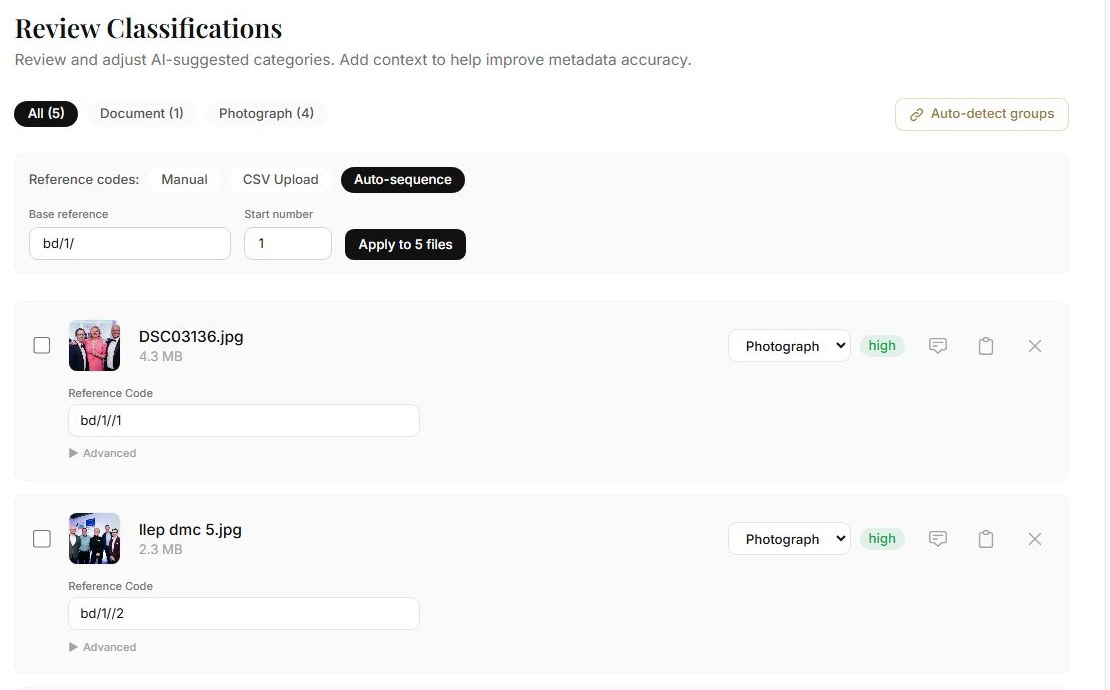
Every field

reviewed by a human before it enters the catalogue — AI drafts, you decide

8+

standards exports: EAD3, AtoM CSV, ArchivesSpace CSV, Dublin Core, Spectrum CSV, BagIt+PREMIS…

EU

data residency — all AI processing runs in EU data centres

Alongside Axiell Calm, Modes & CollectionsIndex+

If you’re searching for a “Calm alternative” or “Axiell alternative”, the question is often not the database — it’s the backlog.

Established collections management systems like Axiell Calm, Modes and CollectionsIndex+ are where finished records live. They are good at that. What they don’t do is create the records in the first place — the describing, transcribing and structuring that makes a backlog catalogueable at all.

That’s the layer Archivers.ai adds. AI drafts the record, a human reviews and accepts every field — with per-field confidence scores, per-field provenance and an audit trail — and the result exports in formats your CMS can import. You keep your system of record; you gain the cataloguing capacity.

Archivers.ai Legacy CMS (typical)
AI cataloguing layer Review-gated AI drafting of whole records Records are created manually, elsewhere or not at all
Pricing Transparent pricing, published when we launch ~ Generally quote-only — pricing not published
Deployment Cloud-native — works in the browser, nothing to install ~ Often desktop or legacy installations requiring IT support
Works with your CMS Exports EAD3, CSV, Dublin Core, Spectrum CSV for import It is your CMS — and stays that way

We compare on public facts only. Your existing CMS does its job well — Archivers.ai feeds it better records, faster.

Alongside Preservica

Preservica preserves. Archivers.ai catalogues. You may well want both.

Digital preservation platforms like Preservica are built to keep digital objects safe, intact and renderable for the long term. That is a different job from describing them — and a preservation system is only as findable as the metadata that goes into it.

Archivers.ai produces that metadata: review-gated catalogue records with per-field provenance, exported as BagIt packages with PREMIS metadata, EAD3, or CSV that flow into preservation workflows.

Archivers.ai Preservica
Core job Cataloguing & public access — turning backlogs into described, searchable records Long-term digital preservation of files and objects
Relationship Complementary — Archivers.ai exports (BagIt+PREMIS, EAD3, CSV) flow into preservation systems
AI cataloguing pricing Transparent pricing, published when we launch

Alongside Transkribus

Transkribus transcribes the page. Archivers.ai produces the whole catalogue record.

Transkribus is a well-regarded tool for transcribing handwritten and printed pages. But a transcript is one field of a catalogue record — not the record itself.

Archivers.ai includes transcription on paid plans and drafts the rest: ISAD(G)-aligned description, dates, fonds hierarchy, controlled vocabulary suggestions (never invented by the AI), all gated behind human review. Then it makes the result searchable, publishable through a public portal, and exportable in standards formats.

Archivers.ai Transkribus
Transcription Included on paid plans (documents, plus audio & video) Core strength — handwritten & printed text
Full catalogue record ISAD(G)-aligned description, hierarchy, vocabularies, review gate Transcription-focused
Public access portal Included on paid plans ~ Read-and-search sites for transcribed collections
Standards exports EAD3, AtoM/ArchivesSpace CSV, Dublin Core, Spectrum CSV, BagIt+PREMIS, PDF ~ Transcript-oriented formats

Beyond the spreadsheet

Spreadsheets feel free. Then the third cataloguer joins.

A spreadsheet has no standards model, so every contributor describes things differently. It has no search infrastructure, so finding anything means scrolling. And it has no public face, so the collection stays invisible.

Archivers.ai gives a volunteer with a phone the same foundations as a county record office: ISAD(G)-aligned records with human review, full-text search across the collection, a public access portal, and exports that mean your data is never stranded. Archivers.ai is in early access — join the waitlist and every account is personally onboarded.

Archivers.ai Spreadsheets
Standards compliance ISAD(G), EAD3, Dublin Core, Spectrum Whatever each contributor types
Search Full-text search across records and transcripts Ctrl+F
Public access Public portal included on paid plans None
AI assistance Review-gated drafting with confidence scores None
Pricing Transparent pricing, published when we launch Free — until staff time is counted

Capacity, not replacement

Whatever your stack, the constraint is the same: there will never be enough hands to catalogue everything.

Archivers.ai adds capacity. AI drafts the records; your team reviews and accepts every field before it enters the catalogue, with per-field confidence scores, per-field provenance and an audit trail. All AI processing runs in EU data centres. And we’re committed to transparent pricing, published when we launch — so the cost can go straight into a grant budget or committee paper without a sales call.

Join the waitlist Book a demo Book a Backlog Sprint

FAQ

Is Archivers.ai a Calm or Axiell alternative?

Archivers.ai is the AI cataloguing layer rather than a like-for-like replacement for a collections management system. It turns uncatalogued material into review-gated, standards-compliant records, then exports them in formats your existing CMS can import — EAD3, CSV, Dublin Core and more. Many teams searching for a Calm or Axiell alternative actually need cataloguing capacity, which is exactly what Archivers.ai adds. Unlike most sector systems, Archivers.ai is committed to transparent pricing, published when we launch.

Does Archivers.ai replace Preservica?

No — they solve different problems. Preservica is a digital preservation platform; Archivers.ai is a cataloguing and access platform. They are complementary: Archivers.ai produces the descriptive metadata and exports packages such as BagIt with PREMIS metadata that flow into preservation systems.

How is Archivers.ai different from Transkribus?

Transkribus specialises in transcribing pages of handwritten and printed text. Archivers.ai produces the whole catalogue record — transcription included on paid plans, plus ISAD(G)-aligned description, fonds hierarchy, controlled vocabulary suggestions, a public access portal, and standards exports.

How is Archivers.ai different from a spreadsheet?

Spreadsheets are flat lists with no standards model, no search infrastructure, and no public access. Archivers.ai generates structured, ISAD(G)-aligned records with human review, makes the collection searchable, publishes it through a public portal, and exports in archival formats like EAD3 and BagIt.

Will Archivers.ai publish its prices when most sector software is quote-only?

Yes. Procurement shouldn’t require a sales call, so Archivers.ai is committed to transparent pricing, published when we launch — so archives can put a number straight into a grant budget or committee paper.