
Winning an NLHF grant is a significant achievement. Staying compliant with the conditions attached to it is where many heritage organisations struggle. The National Lottery Heritage Fund’s Heritage 2033 strategy sets clear expectations for how digital outputs should be managed, licensed, stored, and made accessible. These are not suggestions; they are conditions tied to your grant agreement, your final drawdown payment, and your organisation’s reputation as a credible steward of public funding.
This article sets out a practical compliance framework for NLHF-funded digital heritage projects. It covers the five pillars that fund reviewers and monitors assess — drawn from the NLHF’s digital good practice guidance — scope, openness, accessibility, availability, and governance — and provides a concrete reference for project managers, archivists, and directors who need to demonstrate that their digital outputs meet the required standard.
If your project cannot demonstrate compliance at final evaluation, you risk delayed or withheld payments — and you make it harder for your organisation to secure funding in future.
Why digital compliance matters
Digital compliance is not an administrative box-ticking exercise. It is the mechanism by which public funding is converted into enduring public value. Without it, heritage assets are lost to technological obsolescence, data degradation, or legal restriction. The NLHF’s four investment principles — Saving Heritage, Protecting the Environment, Inclusion and Access, and Organisational Sustainability — all carry specific implications for how digital outputs are produced, described, stored, and shared.
For a practical look at how AI tools can help you meet these requirements, see our guide to meeting NLHF digital good practice with AI. Every digital activity in your project must be traceable back to these principles. If a fund monitor asks why a particular decision was made — why that file format, why that licensing model, why that storage arrangement — you need an answer grounded in these pillars, not in convenience or habit.
Defining your scope of works
Compliance problems frequently begin with inadequate scoping. If your project does not precisely define its digital outputs at inception, you will encounter budget overruns when storage, licensing, and archiving costs arrive later than expected.
Your scope of works should explicitly categorise every regulated digital output the project will produce:
- Digitisation outputs — bound volumes, archive collections, photograph collections, film, and audio-visual material
- Technological outputs — 3D models, photogrammetry data, VR tours, software code
- Data and documentation — datasets, metadata, project reports, educational toolkits
- Infrastructure and capacity — hardware, software procurement, and staff training
Each category carries different licensing, storage, and preservation requirements. A photograph collection digitised from glass plate negatives demands different metadata, file format, and rights management treatment from a born-digital dataset. Defining these distinctions upfront prevents compliance gaps from emerging at the final evaluation stage.
The openness pillar: licensing and intellectual property
The NLHF expects digital outputs to be open by default. Open access enables creative reuse and ensures global reach — removing legal barriers so the public can transform and build upon heritage resources.
Default licensing requirements
The licensing position is straightforward:
| Output type | Required licence |
|---|---|
| Original content (text, images, video, research) | Creative Commons Attribution 4.0 (CC BY 4.0) |
| Metadata, data, and software code | Creative Commons Zero 1.0 (CC0 1.0) |
| Digital reproductions of public domain works | CC0 1.0 — no new rights may be claimed |
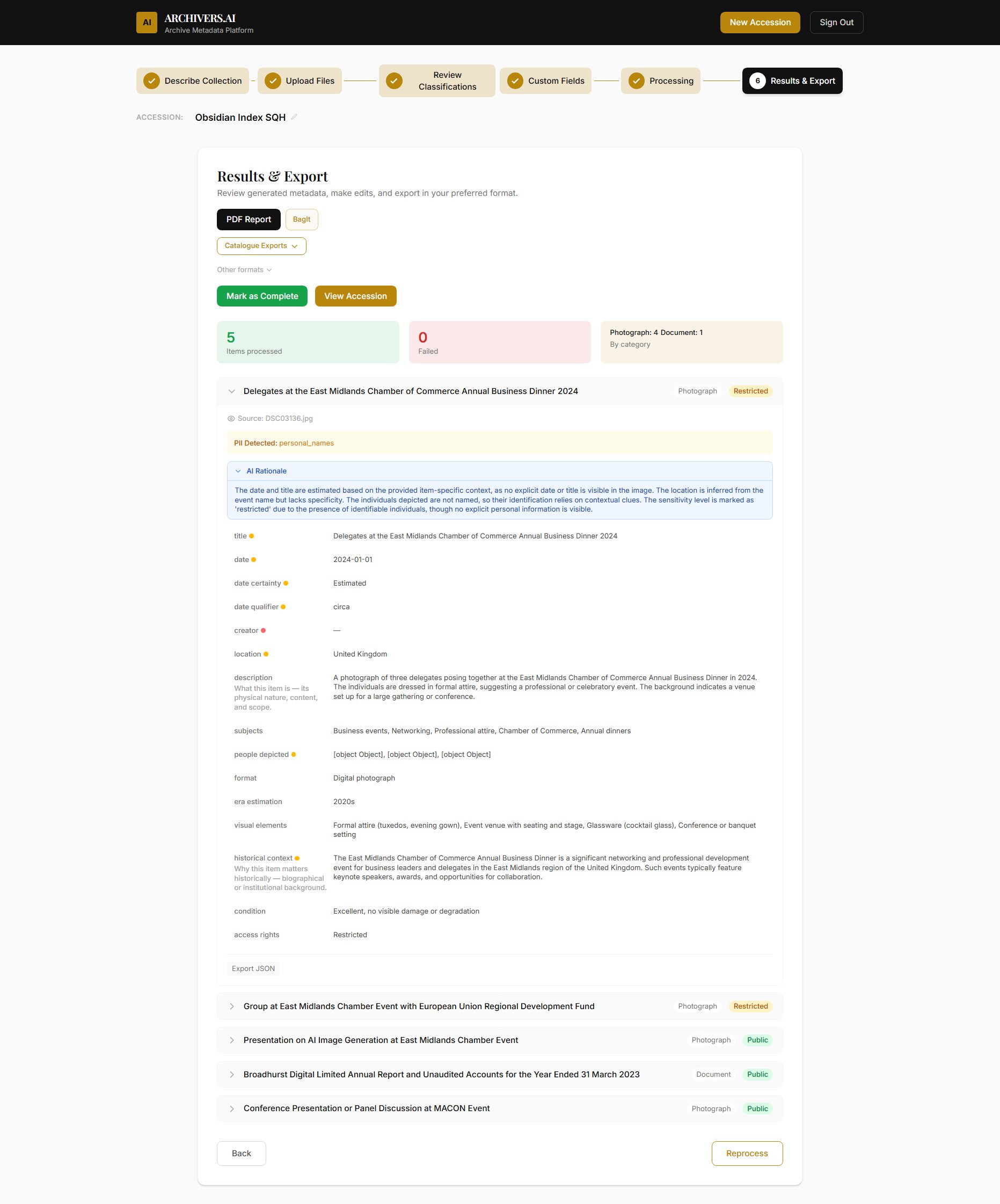
This means your metadata exports must be in open, interoperable formats that support CC0 1.0 dedication. For a detailed breakdown of which metadata standards the NLHF expects, see our guide to NLHF metadata standards including ISAD(G), EAD3, and Dublin Core. Archivers.ai exports in EAD3 XML, Dublin Core, and CSV — all open formats designed for exactly this purpose. The platform includes rights management fields and sensitivity levels (public, restricted, and closed) to help you manage the exceptions listed below, while its PII detection flags special category data before open licensing is applied. This prevents accidental publication of material that should be restricted.
Recognised exceptions
Not everything can or should be openly licensed. The NLHF recognises four categories of exception, each of which must be formally documented:
- Depictions of minors — outputs featuring individuals under 18
- Special category GDPR data — sensitive personal information such as specific oral history disclosures
- Culturally sensitive material — spiritual works, funerary objects, or human remains
- Orphan works — material where the copyright owner is unknown and cannot be located
For all third-party contributions from volunteers, contractors, or partners, you must secure written non-exclusive licences confirming that the contributor understands their work will be shared under an open licence. Full assignment of rights is not required, but written informed consent is non-negotiable.
The accessibility pillar: inclusion and technical standards
Digital accessibility is a non-negotiable requirement of the NLHF’s Inclusion principle. If a digitised resource is technically unreachable — by screen reader users, by people on mobile devices, by anyone with a disability — it provides no public benefit and fails the compliance test.
Mandatory accessibility tiers
The accessibility requirement scales with your grant:
- Grants from 10,000 to 250,000 pounds — minimum WCAG Single A
- Grants above 250,000 pounds — minimum WCAG Double A
Your compliance checklist should cover WCAG adherence across all web content, mobile optimisation, logical navigation, visible CC licensing badges, and (for high-value grants) a professional accessibility audit.
Making digitised content machine-readable
A critical but often overlooked accessibility requirement is that digitised content must be machine-readable and screen-reader compatible. A scanned image of a document is not accessible if the text within it cannot be read by assistive technology.
Archivers.ai’s OCR and transcription tools process digitised items to extract text content, making it machine-readable and screen-reader compatible. This directly supports WCAG compliance and removes a barrier that many heritage projects fail to address until it is too late.
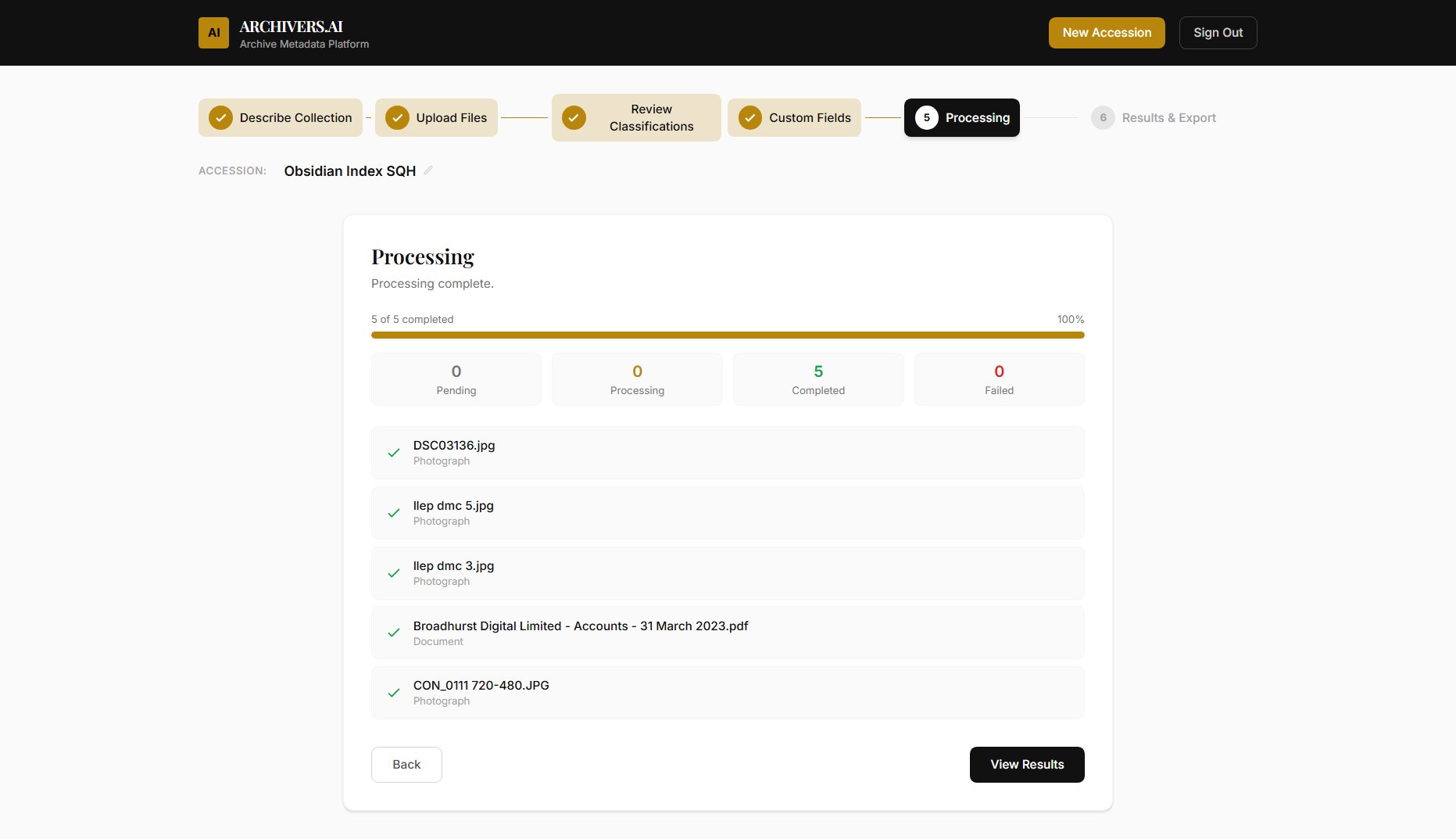
Metadata enrichment is equally important for accessibility. Consistent, structured metadata allows users to find, navigate, and actually use heritage materials. Cataloguing is not merely organisational — it is a vital compliance tool for discoverability.
The availability pillar: public access and preservation
Digital assets are at risk from the moment of creation. Without active management, they face technological obsolescence. The NLHF sets explicit minimum availability timelines:
- Projects up to 250,000 pounds — minimum 5 years post-completion
- Projects above 250,000 pounds — minimum 20 years post-completion
These are minimum thresholds. A well-governed project should plan for availability that extends well beyond these periods.
The 3-2-1 rule for digital storage
The sector-standard approach to storage resilience is the 3-2-1 rule:
- 3 copies of all data
- 2 different media types (for example, local server and cloud)
- 1 offsite backup in a physically separate location or secure cloud environment
Grantees do not necessarily need to host materials on their own servers indefinitely. Compliance is met by ensuring unfettered public access via established repositories. Your sustainability plan should include deposits to the UK Web Archive (for websites), GitHub (for code), or Wikimedia Commons (for public domain images).
Creating preservation-ready packages
The practical challenge is producing export packages that trusted repositories will actually accept. This requires standardised packaging with embedded preservation metadata.
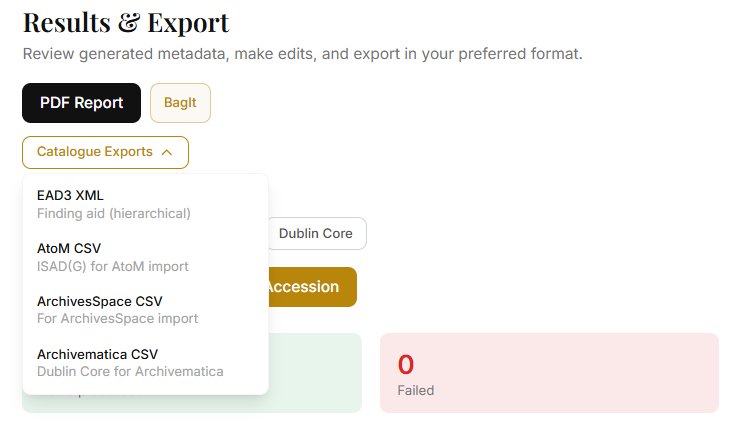
Archivers.ai’s BagIt export includes PREMIS preservation metadata, creating packages that are ready for deposit in trusted digital repositories without further manual preparation. Its EAD3 XML exports are platform-agnostic, meaning your catalogue data survives regardless of which system your organisation uses in five or twenty years — and feeds directly into aggregate discovery services such as The National Archives Discovery portal. This is the difference between a digital output that meets the letter of the availability requirement and one that is genuinely resilient. For a deeper look at backup and storage strategies, see our guide to digital archive backup and storage.
The 10-step digitisation lifecycle
Governance is not a single checkpoint. It is a cohesive lifecycle, and the NLHF expects project managers to verify compliance at each stage. The following ten steps represent the full digitisation lifecycle, with the Lead Auditor’s compliance actions at each stage:
- Planning — verify that the project vision is documented and explicitly aligned with all four NLHF investment principles
- Rights clearance — ensure written informed consent and non-exclusive licences are secured for 100% of third-party contributions
- Team organisation — audit the team’s skill set and document a formal training plan for identified technical gaps
- Equipment selection — verify that hardware specifications meet the required output quality for the intended audience
- Digitisation — review a sample of the first 5% of outputs to ensure they meet professional technical standards before proceeding at scale
- Editing — confirm that master files (TIFF, WAV) are preserved uncompressed before any derivative editing or compression
- Metadata — verify that a standard set of fields is used consistently across all datasets to ensure data portability
- Storage — perform a restore test on at least one backup copy from the offsite location to verify data integrity
- Publication — confirm that the chosen platform supports the display of mandatory CC BY 4.0 badges and attribution
- Deposit — secure written confirmation or receipt from the long-term repository where assets have been archived
Steps 7, 8, and 9 are where many projects lose momentum. After months of digitisation and editing work, teams discover that their metadata is inconsistent, their storage approach was not tested, or their publication platform does not support the required licensing display.
Archivers.ai handles these three steps within a single workflow. Its structured metadata fields enforce consistency across your entire dataset (Step 7). Its BagIt and EAD3 exports create standards-aligned packages ready for repository deposit (Step 8). And its publication-ready outputs include the licensing and attribution information that the NLHF requires (Step 9).
For a complete walkthrough of the digitisation process from planning through deposit, see our complete guide to digitising an archive.
Budget verification
Your project budget must explicitly include the following cost lines to ensure compliance. Fund monitors will look for these at evaluation:
- Outsourced professional services and fees — specialist digitisation, conservation assessment, or metadata consultancy
- Professional accessibility auditing — third-party WCAG compliance verification
- Data storage, cloud subscriptions, and long-term archiving fees — including any repository deposit charges
- Software subscriptions — tools used for cataloguing, metadata enrichment, and export. An Archivers.ai subscription fits comfortably under this budget line and is straightforward to justify to fund monitors as a direct project cost
- Staff training and volunteer participation costs — covering the skills development that the Organisational Sustainability principle requires
- Contingency — a mandatory buffer of 5 to 10 per cent to manage unforeseen economic or technical shifts
For a full breakdown of how to structure these costs, see our guide to budgeting for digitisation in an NLHF bid. Failure to include these lines is a common cause of budget challenges in the final project phase. Storage and licensing costs that were not scoped at inception become urgent problems when the grant period is ending and the final drawdown depends on demonstrated compliance.
AI governance
The NLHF recognises that artificial intelligence tools are increasingly used in heritage digitisation, particularly for OCR, handwritten text recognition, and metadata enrichment. Where AI is utilised, three specific audit rules apply:
Data privacy
Inputting sensitive or personal data into free or public AI tools is strictly forbidden under GDPR. This is not a grey area — it is a potential data breach. Any AI processing of heritage materials containing personal data must occur within a controlled environment where data does not leave the organisation’s oversight.
Accuracy mandate
All AI-generated content — OCR transcriptions, HTR outputs, automated descriptions — must undergo human verification. AI outputs are drafts, not finished records. Our guide to human-in-the-loop AI and what heritage funders expect explores this principle in detail. The NLHF expects a documented review process that demonstrates how accuracy was verified before publication.
Environmental consideration
AI queries consume 50 to 90 times more energy than conventional online searches. The NLHF’s Protecting the Environment principle requires grantees to use AI only where it significantly improves quality or accessibility, not as a default for tasks that could be completed conventionally.
Archivers.ai addresses all three requirements. Sensitive data does not leave the controlled environment during processing. Every AI-generated metadata field cites its evidence or is flagged as having none, making human review targeted and efficient rather than requiring reviewers to check everything from scratch. And batch processing mode reduces the energy overhead of repeated individual queries by grouping items for efficient processing.
Verification evidence for final drawdown
To trigger your final grant payment, you must submit the following evidence:
- Final completion report and project evaluation — demonstrating that the project delivered against its approved purposes
- Proof of public access — live URLs, repository deposit receipts, or aggregator links showing that digital outputs are publicly available
- Job descriptions and briefs — documented proof of the roles and requirements for all funded staff and consultants
This is the point at which every compliance decision made during the project either pays off or creates problems. If your metadata is in a proprietary format that cannot be exported, if your storage has no verified backup, if your licensing is undocumented — these gaps become visible at final drawdown and can delay or reduce your payment.
Three executive success factors
If you take nothing else from this framework, remember these three principles:
- Evidence-based need — consultation feedback must explicitly justify the necessity of every digital output. Do not digitise material because you can; digitise it because there is documented demand
- Rights-first workflow — all licensing and third-party permissions must be cleared before digitisation begins, not retrofitted afterwards
- Proportional evaluation — evaluation and accessibility audit costs must be present in the budget regardless of project size. Small projects are not exempt from demonstrating impact
Building compliance into your workflow
Compliance is not something you bolt on at the end of a project. It is built into every decision from scoping through to final deposit. The organisations that navigate NLHF digital requirements successfully are those that choose tools and workflows designed for standards compliance from the outset — rather than discovering at final evaluation that their outputs do not meet the required standard.
Archivers.ai is built specifically for heritage organisations working to these standards. Its structured metadata, open-format exports, preservation packaging, and AI governance features address the compliance requirements set out in this framework at every stage of the digitisation lifecycle. Visit our standards page for a full list of supported archival standards, or explore our heritage funding resource for guidance tailored to funded projects.
If your organisation is planning or delivering an NLHF-funded digitisation project, discuss your NLHF project or start free and see how the platform supports compliant digital heritage work from day one.