
Artificial intelligence has moved from the margins of heritage practice to the centre of funder expectations. Under the National Lottery Heritage Fund’s (NLHF) “Heritage 2033” strategy, digital skills and technologies are treated as essential components of any serious preservation effort. But funders are not writing blank cheques for automation. They want to see that AI is supervised, accountable, and ultimately governed by the professionals who understand the material.
This is the principle known as Human-in-the-Loop (HITL) — and it has become the single most important concept for any organisation planning to use AI in a heritage funding bid.
This guide explains what HITL means in the context of NLHF applications, how to demonstrate it in your project plan, and how modern archival platforms can help you meet funder expectations without building a bespoke technology stack from scratch.
Why funders insist on human oversight
The Heritage Fund acts as guardian of the public purse. When it invests in a digitisation project, it expects the outputs — the transcriptions, metadata, digital surrogates — to be reliable enough to serve as permanent public records. AI systems, for all their power, produce errors. Language models hallucinate. OCR engines misread damaged text. Automated classifiers miss cultural nuance.
None of this makes AI unusable. It makes it a tool that requires supervision.
The NLHF’s position is straightforward: AI may assist, but it must not replace professional judgement. Project plans that present AI as a black box — material goes in, catalogued records come out — will not pass scrutiny. Funders want to see a verification framework: clear documentation of where AI is used, what humans check, and how errors are caught before data reaches the public.
This is not a theoretical preference. It maps directly onto the four NLHF investment principles that every bid must address. For a broader look at digital compliance, see our guide to meeting NLHF digital good practice with AI.
Aligning AI with the four investment principles
Funding is awarded based on outcomes, not the sophistication of the technology involved. When integrating AI into a heritage project, the question is always “so what?” — how does this tool advance the funder’s goals?
Saving heritage
AI tools such as Handwritten Text Recognition (HTR) and Optical Character Recognition (OCR) can revitalise “heritage at risk” — material in poor condition, or collections so large they have never been properly catalogued. A county record office sitting on thousands of handwritten registers can use HTR to produce searchable transcriptions at a pace that manual work could never match.
The key for funders is that these transcriptions are verified. An unreviewed AI transcription of a parish register is not an archival record — it is a draft. The HITL element is what transforms raw AI output into a trustworthy resource.
Archivers.ai handles all of these formats within a single platform. Typed documents receive OCR processing. Handwritten items — ledgers, diaries, correspondence — are processed through HTR. Audio files receive automatic transcription with a synchronised waveform player and editable text. Video content gets real-time transcription. This is the kind of “intelligent digitisation” funders expect: not just scanning, but structured data capture that makes collections genuinely searchable.
Protecting the environment
AI has a significant energy footprint. Research suggests that a single ChatGPT query uses between 50 and 90 times more energy than a conventional web search. Heritage funders are increasingly aware of this, and bids that propose heavy AI use without addressing environmental impact will face questions.
The mitigation is twofold. First, the reduction in physical travel and handling of fragile originals that digital access provides. Second, responsible compute practices.
Archivers.ai addresses this directly with a batch processing mode that queues items for lower-cost, more energy-efficient processing during off-peak server times. Rather than running every item through GPU-intensive AI models on demand, batch mode consolidates processing into windows when energy grids are less strained and compute costs are lower. This is a practical, demonstrable response to the environmental concern — and exactly the kind of detail that strengthens a funding bid.
Inclusion, access, and participation
This is where AI-powered heritage projects have the greatest potential to deliver transformative impact. AI-driven transcription and metadata enrichment remove barriers for audiences who cannot visit physical reading rooms — people with mobility limitations, those living far from the archive, print-disabled readers, and communities whose heritage has historically been under-represented in catalogues.
But access requires more than putting records online. It requires making them findable and understandable by people who are not trained researchers.
Archivers.ai includes a “Research and Explore” AI chat interface that lets the public query collections using natural language — plain English questions rather than Boolean search syntax. Think of it as something like ChatGPT, but grounded entirely in your actual collection data: the verified metadata, transcriptions, and catalogue records that your team has reviewed. It does not hallucinate or draw on external training data. It answers questions based on what is genuinely in your archive.
This directly fulfils the NLHF’s “Inclusion, Access, and Participation” principle by removing the search literacy barrier that excludes many potential users. A community member can ask “What records do you have about families living on Brook Street in the 1890s?” and receive meaningful results — without needing to know which fonds to search or what catalogue reference to use.
Organisational sustainability
The NLHF does not fund one-off technology experiments. It funds projects that build lasting capacity. When AI tools are introduced, funders expect a plan for how staff and volunteers will be trained to use them, and how the organisation will maintain the technology after the grant period ends.
This means the chosen platform matters. A tool that requires a software engineer to operate is not sustainable for a local history society staffed by volunteers. A tool designed for archivists — with intuitive workflows, clear guidance, and minimal technical prerequisites — is.
Archivers.ai was built with this principle in mind. The platform is designed for heritage professionals and volunteers, not developers. Workflows guide users through each stage of the digitisation process, from upload through AI processing to human review and export. Training staff on the platform builds lasting digital skills — skills that transfer to other digital heritage work long after any individual project concludes. Volunteers can contribute to cataloguing with minimal training, expanding your organisation’s capacity without requiring specialist recruitment.
The digitisation pipeline: from data capture to metadata enrichment
Funders now expect to see a clear, end-to-end description of how digital records will be created. This means documenting every stage of the pipeline, from initial scanning through to publication. The concept of “intelligent digitisation” — moving beyond simple image capture to create deeply searchable, interconnected datasets — has become a baseline expectation.
The key AI-driven stages in a modern digitisation pipeline are:
Automated data capture. OCR for typed text and HTR for handwritten material transform static images into fully searchable text. A collection of 10,000 handwritten register pages becomes a dataset where users can search for specific names, dates, and places across the entire corpus.
Multimedia transcription. Heritage collections are not limited to paper. VHS tapes, Betamax cassettes, audio reels, and oral history recordings all contain information that AI can now surface. Automatic speech-to-text transcription converts audio into searchable text, opening up collections that were previously accessible only by listening to every recording in full.
Metadata enrichment. AI can extract and structure metadata from document content — identifying people, places, dates, and subjects to produce rich, queryable catalogue records. This transforms a basic inventory into a research tool.
Each of these stages produces AI-generated output that requires human verification. The pipeline is not complete until a trained person has reviewed the results.
The verification framework: where humans stay in the loop
This is the core of any HITL strategy, and the section of your funding bid that assessors will scrutinise most closely. You need to demonstrate three things: what gets checked, who checks it, and how disagreements between AI output and human judgement are resolved.
Quality control for AI-generated text
Every OCR transcription, every HTR reading of a handwritten page, every automated metadata suggestion must pass through a human review stage. This is not optional. It is the mechanism that transforms AI-assisted output into an archival record.
In practice, this means building review into the workflow rather than treating it as an afterthought. The review stage should be a defined step in the project plan, with allocated staff time and clear quality benchmarks.
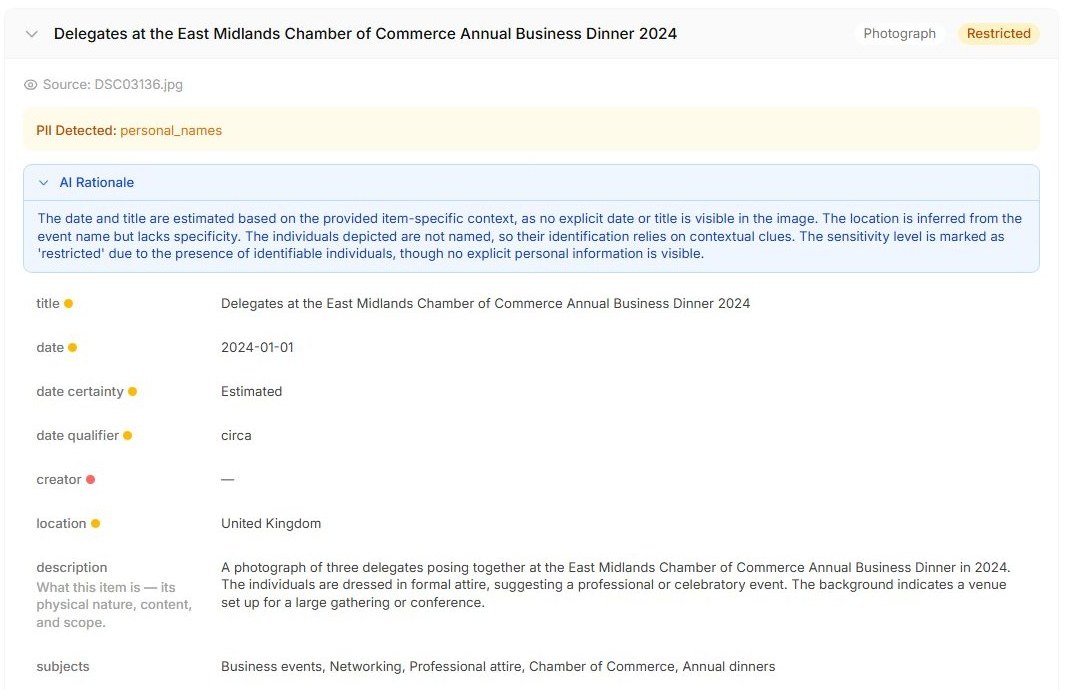
Archivers.ai builds this directly into the platform with a mandatory “Review and Refine” stage. Before any metadata is exported or published, a human archivist reviews every AI suggestion. Each field cites the evidence behind it — or states that it was inferred with no direct evidence — in an “AI evidence” panel that shows where the value came from. If the AI suggests a date of “1847” for a document, the archivist can see whether that was extracted from the text, inferred from surrounding records, or guessed from limited evidence. This transparency makes review faster and more informed — the archivist is not just accepting or amending a suggestion, but understanding the basis for it.
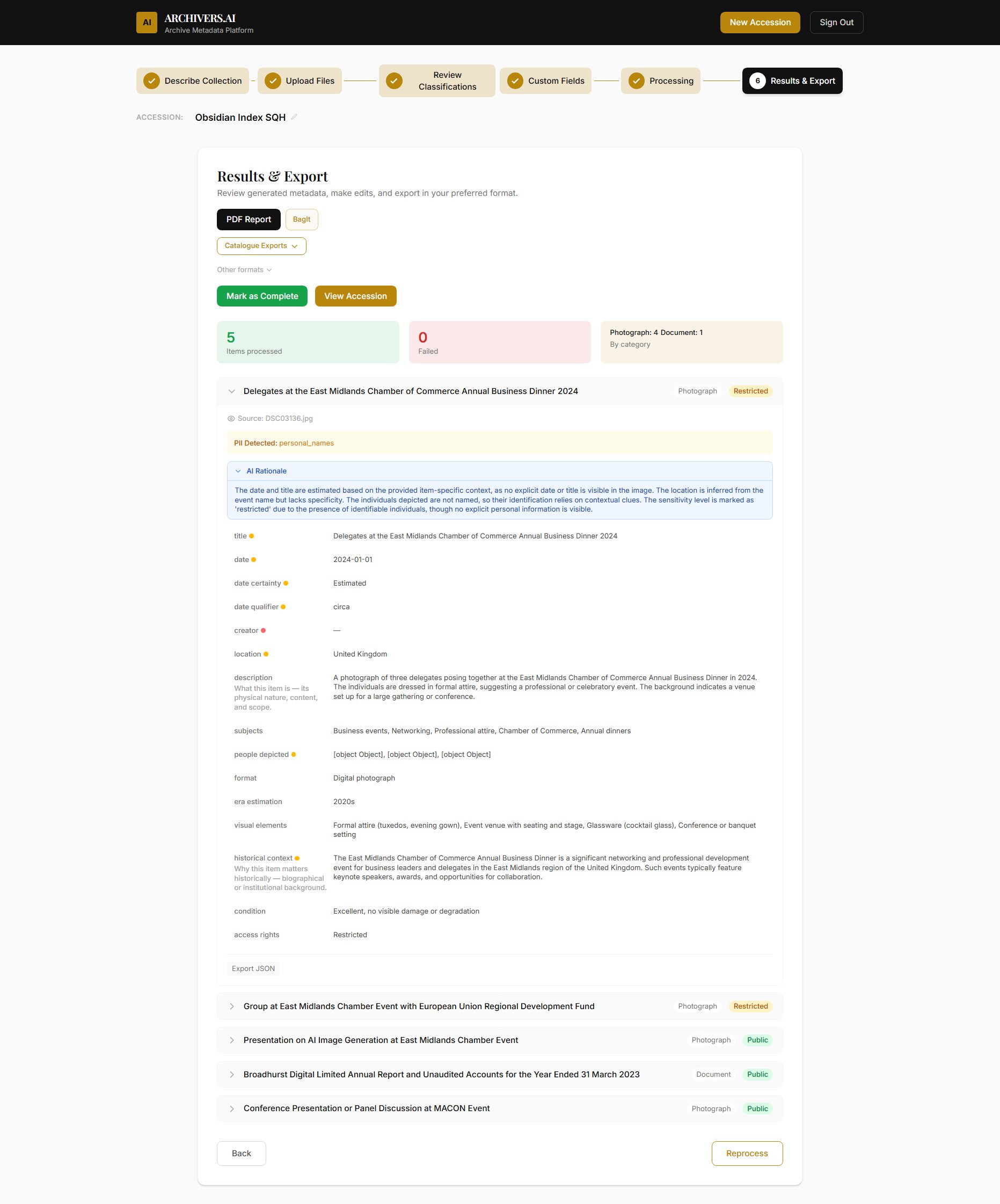
Beyond individual field review, the platform actively flags items that need closer attention. When the OCR is unsure of a word, a field has no direct evidence, the AI identifies potential sensitivity concerns, or it spots possible personally identifiable information (PII), it flags the record for human review. Archivists can then examine the flagged fields, override any AI suggestion, and document their reasoning. This is not a passive review process — it is a structured triage system that directs human attention where it is most needed.
Rights clearance and ethical review
AI cannot navigate the nuances of informed consent, cultural sensitivity, or data protection law. These are areas where human judgement is not just preferred but legally required.
Heritage collections frequently contain material that raises ethical questions: depictions of minors, references to living individuals, culturally sensitive items such as spiritual or funerary objects, and material from communities who were not consulted about its original collection. AI can flag potential issues — a name that matches a living person database, an image classification that suggests a minor is depicted — but the decision about what to do with that information must rest with a trained professional.
For Orphan Works, where the rights holder is unknown, a clear “take down” policy must be in place. National Galleries Scotland provides a useful model here: an accessible process for rights holders to identify their work and request removal.
Archivers.ai supports this through built-in sensitivity levels — public, restricted, and closed — that archivists assign during review. These classifications travel with the record through every stage of the pipeline, ensuring that material flagged as sensitive is never inadvertently published. This structured approach to sensitivity management is exactly what funders want to see documented in a project plan.
Open licensing compliance
The NLHF has clear expectations about openness. Digital reproductions of public domain materials — including images and 3D scans — should be shared under a CC0 1.0 dedication, meaning no new rights arise from the act of reproduction. Original content and documentation should be shared under CC BY 4.0. Metadata and code should be CC0 1.0.
Getting these labels right is a human responsibility. AI can help by suggesting appropriate rights statements based on the date and nature of the material, but a trained person must verify that the correct licence is applied — particularly for material where rights status is ambiguous.
Archivers.ai supports metadata export under CC0 1.0 and content documentation under CC-BY 4.0 by including dedicated rights fields in every metadata record. Combined with the sensitivity levels mentioned above, this gives archivists a structured workflow for correctly categorising items before open licensing is applied. The rights metadata travels with the record through export, ensuring that downstream platforms and aggregators receive clear, accurate licensing information.
Chat interfaces and public engagement
At the publication stage, the focus shifts to meeting audiences where they already are. The days of expecting researchers to navigate complex catalogue hierarchies are numbered. Modern users — particularly younger audiences and community members who are not academic researchers — expect to be able to ask questions in plain language and receive useful answers.
This is where conversational AI interfaces add genuine value to heritage projects. Rather than presenting users with a blank search bar and hoping they know the right terminology, a chat-style interface allows natural language queries: “Show me photographs of the town centre from the 1950s” or “What records mention the textile mill on High Street?”
The critical requirement is that these interfaces are grounded in verified data. A chat interface that draws on unverified AI output — or worse, on the language model’s general training data — risks presenting fabricated information as historical fact. This is exactly the kind of “hallucination” risk that funders are alert to.
The Archivers.ai Research and Explore interface is grounded exclusively in the metadata and transcriptions that have passed through the human review stage. It cannot invent records that do not exist. It cannot embellish catalogue descriptions with plausible-sounding but fabricated detail. It surfaces what is actually in the collection, presented in a way that is accessible to non-specialist users.
Checklist: interactive AI interfaces for heritage projects
When planning a public-facing AI interface for your funding bid, ensure you can demonstrate:
- Accessibility standards. Does the interface meet W3C standards? Double A compliance is mandatory for grants over 250,000 pounds; Single A for smaller grants.
- Longevity of access. What is the availability plan? Twenty years for grants over 250,000 pounds; five years for smaller grants.
- Attribution. Are CC BY 4.0 badges and attribution statements clearly visible?
- Mobile compatibility. Is the interface accessible via smartphone for inclusive reach across diverse communities?
- Data grounding. Can you demonstrate that the chat interface draws only on verified, human-reviewed data?
Using AI in the application process itself
The Heritage Fund acknowledges that applicants may use AI to assist in drafting bids — particularly those with access needs that make extended writing difficult. However, there are important boundaries.
Loss of uniqueness. AI cannot tell the unique story of your community’s relationship with its heritage. Bids must meet the “Understanding Your Heritage” requirement by explaining why the heritage matters to your specific audience. Generic AI-generated prose will not pass this test. For practical tips on crafting a compelling application, see our guide to the secrets of a winning heritage fund bid.
Inaccuracy risks. Proposing plans that AI has generated without professional review can lead to unachievable commitments. The proposals in your application form the basis of your legal agreement with the funder. If an AI tool suggests you can digitise 50,000 items in six months with two part-time staff, and you include that figure without checking it, you are signing up to a target you cannot meet.
Privacy concerns. Do not input commercially sensitive information, personal data, or details about vulnerable communities into public AI tools. This compromises confidentiality and risks non-compliance with UK GDPR.
The safest approach is to use AI for structural tasks — organising your thoughts, checking grammar, formatting tables — while writing the core narrative, budget justification, and community engagement plan in your own words.
Building your HITL framework: a practical summary
For project planners preparing an NLHF bid that involves AI, here is a condensed framework for demonstrating Human-in-the-Loop compliance:
Document every AI touchpoint. List every stage where AI is used — transcription, metadata generation, sensitivity flagging, public search — and describe the human oversight mechanism for each.
Assign clear roles. Specify who reviews AI output, what qualifications or training they have, and how much staff time is allocated to review. Funders want to see this in your budget, not hidden in assumptions.
Define quality benchmarks. What accuracy rate do you expect from AI transcription? What is your process when accuracy falls below threshold? How do you handle disagreements between AI suggestions and human judgement?
Plan for edge cases. Damaged documents, unusual handwriting, multilingual material, culturally sensitive content — how does your workflow handle material that AI is likely to struggle with?
Choose tools that support the framework. A platform that builds human review into its core workflow — rather than requiring you to bolt it on — will be easier to describe in a bid, easier to implement, and easier to sustain after the grant period ends. If you are preparing an NLHF application, our heritage funding page explains how Archivers.ai supports funded projects.
Conclusion: the human at the centre
The strategic lesson from NLHF’s approach to AI is clear: success is measured not by the sophistication of the algorithm, but by the depth of human engagement with the outputs it produces. Funders are not anti-technology. They are pro-accountability. They want to see that AI is making heritage work faster and more accessible, while human expertise ensures it remains accurate, ethical, and meaningful.
By building Human-in-the-Loop principles into your project from the start — choosing platforms that embed review workflows, training staff to work alongside AI tools, and documenting your verification framework clearly in your bid — you position your organisation as a credible, forward-thinking custodian of the heritage in your care.
Ready to see how Human-in-the-Loop AI works in practice? Archivers.ai was purpose-built for heritage organisations preparing NLHF-funded digitisation projects. From intelligent data capture to mandatory human review to public engagement — every stage of the pipeline is designed to meet funder expectations. Discuss your NLHF project or start free and explore the platform with your own collection.