
The National Lottery Heritage Fund’s “Heritage 2033” strategy treats digital technology not as a peripheral add-on but as a core delivery mechanism for inclusion, access, and organisational sustainability. If your project involves digitisation, cataloguing, or any form of digital output, the NLHF’s Digital Good Practice Guidance is not advisory — it is contractual.
This matters for anyone considering AI-assisted metadata enrichment. Tools such as OCR, Handwritten Text Recognition (HTR), and automated transcription can dramatically reduce the cost and time of creating rich, searchable catalogue records. But the outputs of those tools must satisfy three mandatory digital requirements: Availability, Accessibility, and Openness. Fail on any one, and you risk your final grant payment.
This guide explains how each requirement works in practice, how AI tools can help you meet them, and where the risks lie. It is written for archivists, museum professionals, and community heritage groups preparing NLHF applications at any grant level.
The three digital requirements and what they mean for your project
The NLHF digital framework exists to guarantee public benefit — ensuring that the digital legacy of a funded project outlives its funding cycle. The intensity of each requirement scales with your grant size:
| Requirement | Grants £10,000–£250,000 | Grants over £250,000 |
|---|---|---|
| Availability | Digital outputs must remain available for 5 years post-completion | Digital outputs must remain available for 20 years post-completion |
| Accessibility | Websites and content must meet at least WCAG 2.1 Level A | Websites and content must meet at least WCAG 2.1 Level AA |
| Openness | Default open licence: CC BY 4.0 for all digital outputs | Default open licence: CC BY 4.0 for all digital outputs |
From a project-planning perspective, these requirements demand that you budget for proportionate costs from day one. That means long-term hosting, rights management, accessibility auditing, and — critically — export formats that remain usable years after your project software has been superseded.
Availability: making digital outputs last 5–20 years
The availability requirement is straightforward in principle but demanding in practice. Your digital outputs — catalogues, finding aids, digitised images, transcriptions — must remain publicly accessible for the full post-project period. For larger grants, that is two decades.
This means your project plan must address three concerns:
1. Sustainable hosting and deposit. Your outputs need to live somewhere that will outlast any single vendor contract. Trusted digital repositories, institutional hosting, and deposit arrangements with bodies such as The National Archives or the Archaeology Data Service all satisfy this requirement. For a practical comparison of storage options, see our guide to digital archive backup and storage. The critical point is that your data must be exportable in standard, non-proprietary formats.
Archivers.ai addresses this directly. Its BagIt export generates preservation packages with PREMIS metadata baked in — ready for deposit in any trusted digital repository without further reformatting. EAD3 XML exports ensure your finding aids remain platform-agnostic and readable by any standards-aligned system for the full 5–20 year availability window.
2. Format independence. Proprietary formats are a long-term risk. If your catalogue data is locked inside a system that charges annual licence fees, your availability obligation becomes a recurring cost liability. All export formats from Archivers.ai — EAD3 XML, Dublin Core, CSV, and BagIt — are open, non-proprietary standards. There is no vendor lock-in, and no licence fee standing between your data and its continued availability.
3. Migration planning. Even open formats need periodic review. Your application should include a realistic statement about who will be responsible for format migration and at what intervals. AI-generated metadata in open formats makes this dramatically simpler than migrating from a proprietary database.
Accessibility: meeting WCAG requirements through metadata
Digital accessibility is both a core NLHF investment principle and a legal obligation under the Equality Act 2010 and the Public Sector Bodies Accessibility Regulations 2018. Your website and digital outputs must meet the W3C Web Content Accessibility Guidelines (WCAG) at the level specified for your grant tier.
For heritage collections, the accessibility challenge is acute. A photograph with no description is invisible to a screen reader. An oral history recording with no transcript excludes the D/deaf and hard-of-hearing community. A handwritten document with no transcription is inaccessible to anyone who cannot read the original script.
AI metadata enrichment directly addresses each of these barriers:
Transcription and OCR. Archivers.ai’s OCR and transcription capabilities convert images of typed and handwritten text into machine-readable, screen-reader-compatible text. What was previously a locked image becomes searchable, indexable, and accessible content. This is the single most impactful step you can take for WCAG compliance in a digitisation project.
Audio and video transcription. Spoken-word content from oral histories, documentary films, and community recordings is automatically transcribed into searchable text. These transcripts serve double duty: they provide the basis for closed captioning (a WCAG Level A requirement) and they make the content discoverable through keyword search.
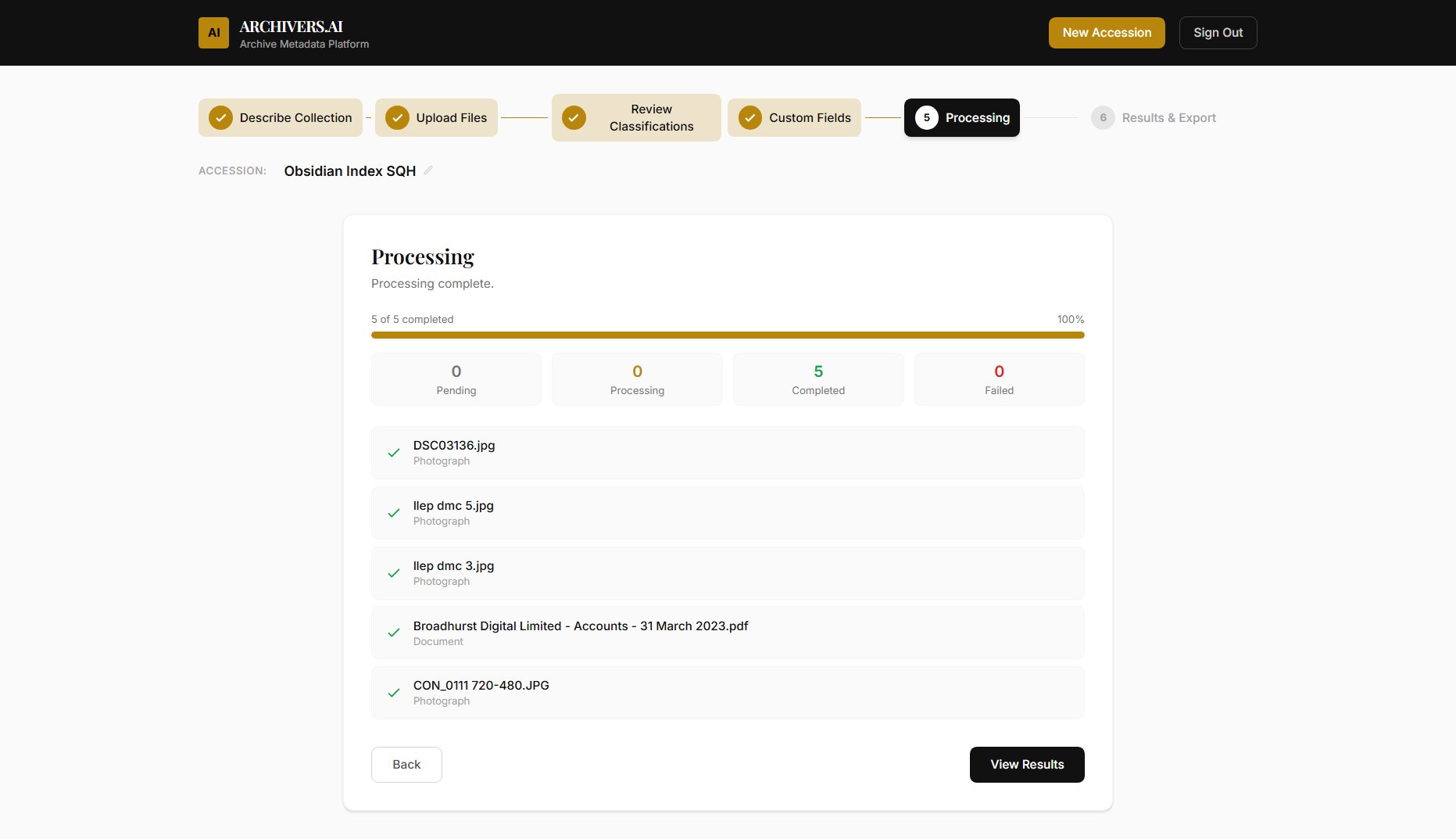
Structured descriptions. Beyond raw transcription, AI-generated metadata fields — titles, subjects, dates, personal names — provide the structured description that assistive technologies rely on. A catalogue record with rich, consistent metadata is inherently more accessible than one with a single-line title and no further context.
The NLHF suggests using tools like VocalEyes for benchmarking your accessibility performance. Build this into your project plan as a periodic check, and use AI-enriched metadata as the foundation that makes those benchmarks achievable.
Openness: licensing AI-generated metadata for public reuse
The NLHF’s openness requirement ensures that publicly funded heritage data is not trapped in digital silos. The default licence for digital outputs is CC BY 4.0, and there is a stricter requirement for metadata specifically:
Metadata, data, and code produced by the project must be shared under a Creative Commons 0 1.0 Universal Public Domain Dedication (CC0 1.0).
This “no rights reserved” approach is critical for interoperability. By dedicating your AI-generated metadata as CC0, you ensure it can be integrated into global aggregators such as Wikidata, Europeana, and the Discovery catalogue at The National Archives without licensing friction.
All metadata exports from Archivers.ai are delivered in open formats — EAD3 XML, Dublin Core, and CSV — that are suitable for CC0 1.0 dedication out of the box. There is no proprietary wrapper, no format conversion needed, and no ambiguity about whether the export is machine-readable.
Handling exceptions. Not everything can be open. Collections containing personal data, sensitive community information, or material covered by third-party copyright require careful handling before any open licence is applied. Archivers.ai’s sensitivity detection and PII flagging help organisations correctly identify these exceptions before applying open licensing — reducing the risk of inadvertent disclosure while still defaulting to openness wherever possible.
The public domain reproduction rule. The NLHF is clear: no new rights should arise from the reproduction of public domain works. If you use AI to digitise and describe assets already in the public domain, you cannot claim new copyright over those digital outputs. Your metadata, likewise, enters the public domain under CC0. This is not a limitation — it is the entire point.
If your project involves natural heritage, species and habitat records must also be shared with the National Biodiversity Network (NBN) Atlas or a Local Environmental Records Centre (LERC), ensuring your project contributes to the wider national environmental record.
Data capture: transforming raw files into searchable assets
The data capture stage is where heritage is made visible, inclusive, and meaningful. Without accurate metadata, your digital archive remains a locked room — high-resolution images that no one can find, audio recordings that no one can search, documents that no one can read.
AI-enabled capture methods unlock this value at scale, moving beyond simple digitisation to true data enrichment. Archivers.ai handles documents, photographs, artefacts, audio, and video in one unified workflow. OCR, HTR, and audio/video transcription run automatically upon upload. The AI then extracts 18+ structured metadata fields per item — including dates, people, places, subjects, document types, physical descriptions, and contextual notes.
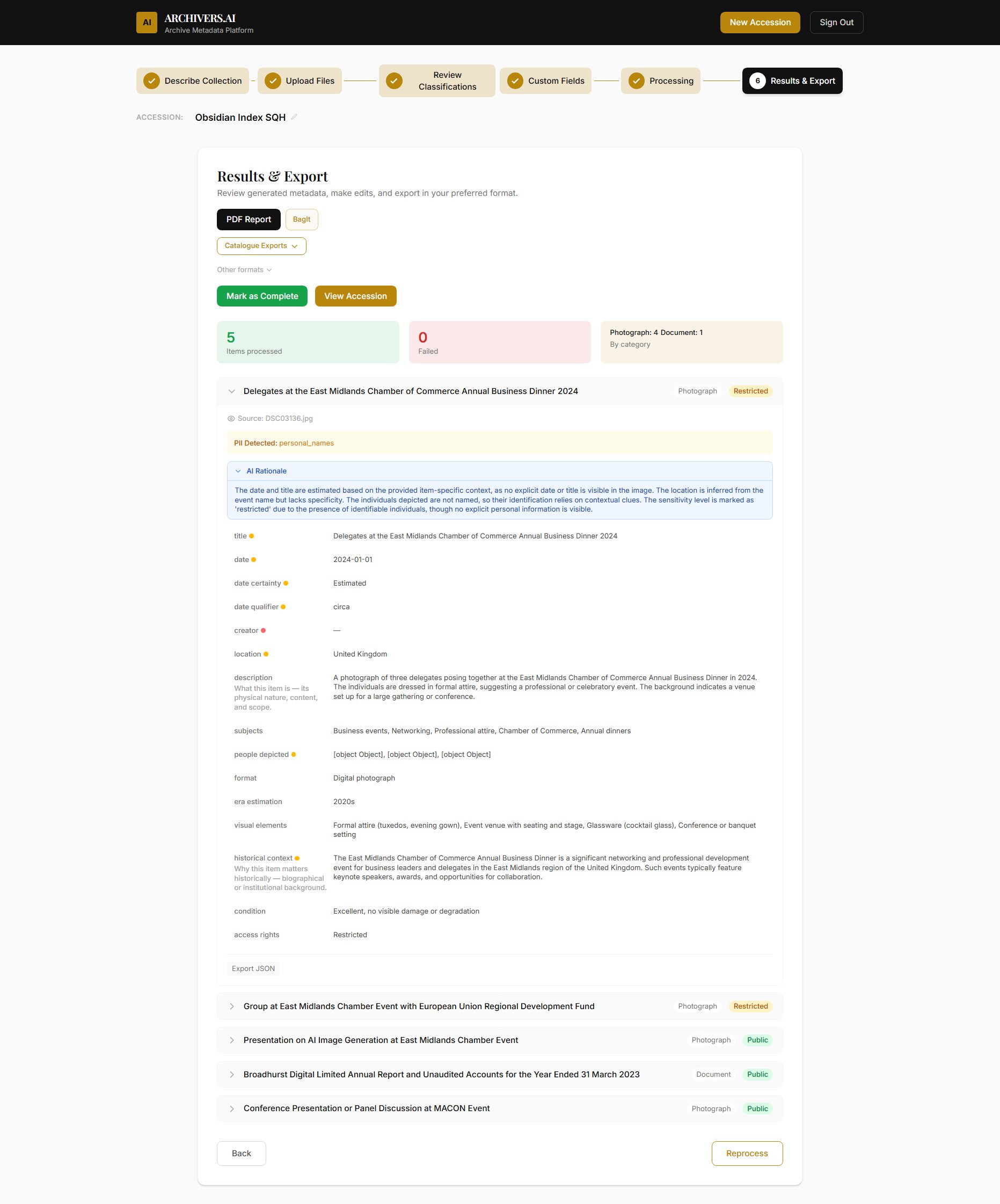
The key AI-enabled methods and their significance for your NLHF application:
-
Handwritten Text Recognition (HTR) transforms cursive journals, diaries, and registers into machine-readable text. It bridges the palaeography gap, making records accessible to audiences who cannot read historic scripts — directly supporting the Inclusion investment principle.
-
Optical Character Recognition (OCR) converts typed text from reports, index cards, and printed archives into searchable data. It enables instant keyword searching across massive datasets, transforming a needle-in-a-haystack search into a functional research tool.
-
Audio/visual transcription automatically transcribes spoken word from oral histories and documentary films into text. This provides the foundation for closed captioning and searchable transcripts — vital for both digital accessibility compliance and community engagement.
-
AI-assisted data entry clarifies ambiguous records such as cemetery registers, complex ledgers, and partially damaged documents. Even the most difficult-to-interpret material becomes a fully indexed public asset.
Each of these capabilities contributes directly to the NLHF’s “Saving Heritage” principle: your assets become discoverable, and discoverable assets generate the public engagement that justifies the investment.
Accuracy, ethics, and the hallucination problem
AI offers efficiency, but it introduces risks that can jeopardise your funding if left unmanaged. The NLHF expects informed consent and a human-in-the-loop approach to verify automated outputs. Your application must address these concerns head-on.
The hallucination risk. Large language models and AI recognition systems can produce plausible but incorrect metadata — a date that looks right but is not, a personal name that belongs to someone else, a subject heading that misrepresents the content. If your final digital outputs contain inaccurate or misleading information, you may be in breach of your grant contract. This directly threatens the release of your final 20% grant payment.
Archivers.ai addresses this through multiple safeguards. Every AI-generated metadata field carries a cited source, or a plain flag that it was inferred with no direct evidence, so cataloguers can immediately see which suggestions rest on the page and which require closer inspection. Transcripts carry per-word OCR confidence, so an unreadable word is marked rather than guessed. And the platform enforces mandatory human review before any record is finalised and exported. The result is a governed workflow, not a black box.
Audit and governance. The audit trail in Archivers.ai logs all AI decisions and subsequent human edits, providing the governance documentation that funders expect to see. When an NLHF assessor asks how you verified your AI-generated outputs, you can point to a complete, timestamped record of every decision.
Sensitivity and data protection. Free or cloud-based AI tools often store the data you input, raising GDPR concerns when processing personal or sensitive material. Archivers.ai’s sensitivity flags catch PII and special category data before publication, helping you maintain compliance without requiring a separate review pass. You should still consult your organisation’s GDPR policies before processing personal data through any third-party tool.
Environmental impact. AI queries consume significantly more energy than standard search operations — estimates suggest 50 to 90 times more per query. For larger grants, consider joining the Fit for Future Network to mitigate the carbon footprint of your digital operations, aligning with the NLHF’s “Protecting the Environment” investment principle.
Best practice checklist for AI integration
- Verification: Ensure a human expert reviews all AI-generated metadata for accuracy and integrity before export
- Evidence per field: Use tools that show where each value came from, not just a single pass/fail
- Audit trail: Maintain a documented log of all AI decisions and human corrections
- GDPR compliance: Verify data protection policies before using any third-party AI service
- The 3-2-1 rule: Keep 3 copies of your data, on 2 different media types, with 1 backup stored offsite
The “Digitise on Demand” model
For organisations seeking financial sustainability beyond the grant period, a “Digitise on Demand” approach can be a powerful outcome-led strategy. Rather than digitising an entire collection upfront, you create access copies in response to public requests — using small fees for bespoke digitisation to fund incremental growth of your digital archive.
This model aligns well with the NLHF’s emphasis on organisational sustainability and ongoing public engagement. It also maps naturally to Archivers.ai’s credit-based plans, with every price published. A free tier will cover initial access copies and proof-of-concept work that strengthens your grant application, and when a funded project begins and volumes increase, larger plans scale to support digitisation-on-demand operations without requiring a change of platform or workflow.
All data produced through digitise-on-demand must still adhere to the openness mandates described above. The fee covers the service of digitisation and description, not a proprietary claim over the resulting metadata.
Collection-level analysis: demonstrating impact and outcomes
The NLHF is an outcomes-based funder. Your application must articulate not just what you will digitise, but what difference it will make. “We will digitise 5,000 photographs” is a statement of activity. “We will make 5,000 photographs discoverable, revealing previously undocumented connections between three local communities and the regional textile industry” is a statement of impact.
After processing, Archivers.ai can analyse your entire collection to identify themes, gaps in description, arrangement suggestions, and research potential. This collection-level intelligence helps you articulate exactly the kind of impact and outcomes that NLHF assessors want to see — grounded in evidence from the collection itself, not speculation.
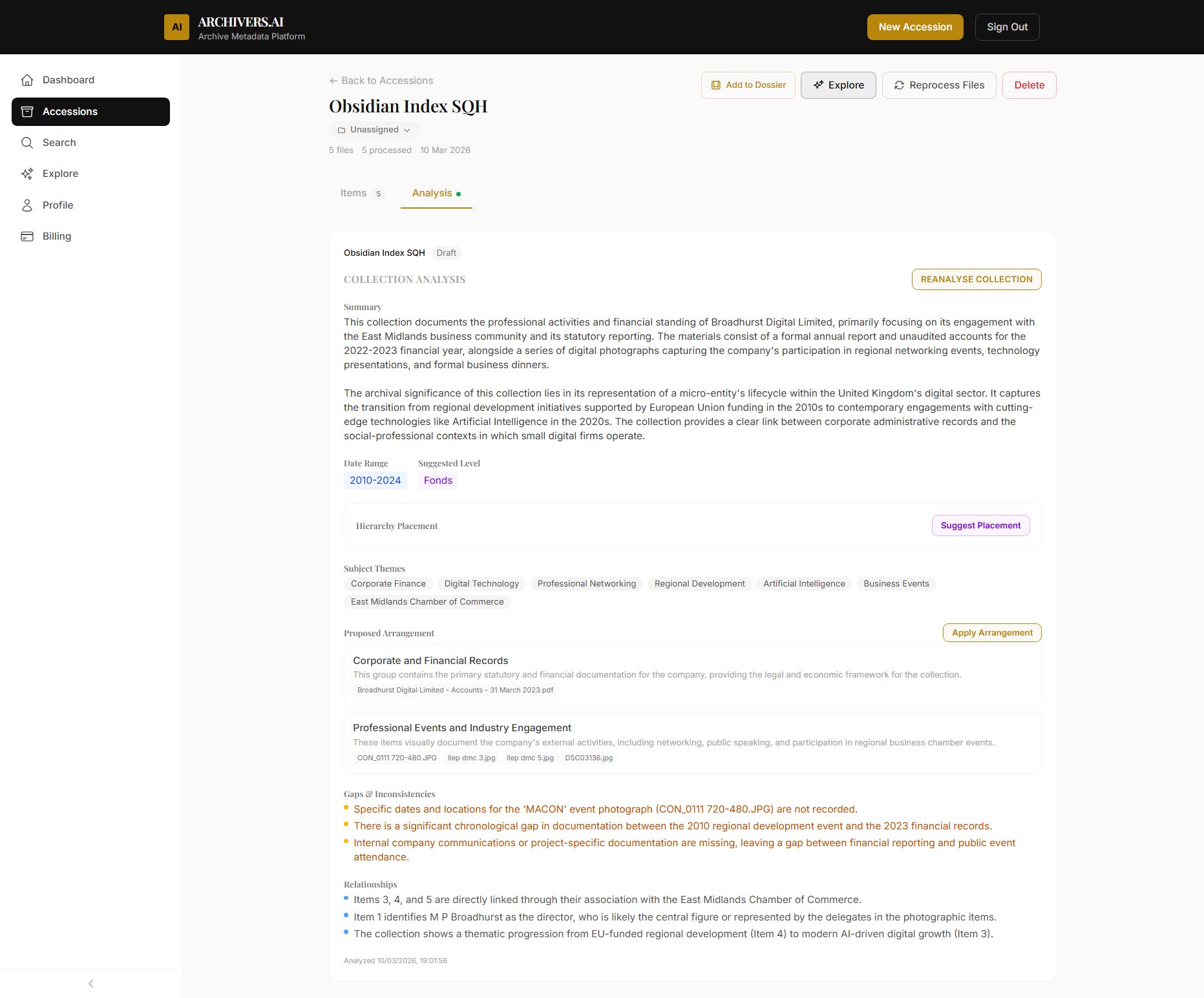
This analysis is also valuable for museum directors and heritage officers who need to make the strategic case for digitisation to boards and trustees. A data-driven summary of what a collection contains — and what it could reveal once properly catalogued — is far more persuasive than a general appeal to heritage value.
Building digital requirements into your project from day one
A successful NLHF application demonstrates that digital good practice is embedded in your project plan, not bolted on as an afterthought. The three requirements — availability, accessibility, and openness — should shape every decision about tools, formats, workflows, and staffing.
Action plan for applicants:
- Consult the Digital Heritage Hub for the latest NLHF technical guidance
- Approach NLHF mentors early in the bidding process to align your AI strategy with regional priorities. Our heritage funding page explains how Archivers.ai supports NLHF-funded projects
- Run a pilot. Process a sample of your collection through Archivers.ai to generate real EAD3 and BagIt exports — concrete evidence of your methodology that you can cite directly in your application
- Budget for the full lifecycle — including long-term hosting, format migration, accessibility auditing, and human review of AI outputs
- Articulate outcomes, not just activities — use collection-level analysis to describe the research potential and community impact your project will unlock
The heritage sector is moving rapidly toward AI-assisted cataloguing and description. Organisations that can demonstrate they are using these tools responsibly — with proper governance, open standards, and accessibility built in — will write stronger bids and deliver better projects.
An archive that is searchable, open, and accessible is an archive that is used. Usage translates to value, and value translates to future funding and institutional resilience.
Ready to build NLHF-compliant digital outputs? Discuss your project or start free with Archivers.ai and generate the export evidence your application needs.