
Metadata is not a technical afterthought in a National Lottery Heritage Fund (NLHF) application. Under the “Heritage 2033” strategy, your digital outputs are the primary evidence that your project meets the Fund’s four investment principles: Saving Heritage, Protecting the Environment, Inclusion, Access, and Participation, and Organisational Sustainability. Get the metadata wrong and your project risks producing digital assets that cannot be searched, migrated, or sustained — the very opposite of what the Fund expects.
This guide explains the three metadata standards that matter most for heritage projects — ISAD(G), EAD3, and Dublin Core — and shows how they work together to satisfy NLHF requirements. It also covers the practical question that derails many bids: how to budget for metadata without blowing your grant on consultancy fees.
Why metadata is a strategic decision, not a technical one
The NLHF’s Digital Good Practice guidance is not optional reading. It sets out mandatory requirements that scale with your grant size:
| Requirement | Grants £10,000–£250,000 | Grants over £250,000 |
|---|---|---|
| Availability | 5 years of unfettered public access | 20 years of unfettered public access |
| Accessibility | W3C Single A standard | W3C Double A standard |
| Openness | CC-BY 4.0 for outputs; CC0 for metadata | CC-BY 4.0 for outputs; CC0 for metadata |
If your project produces 20 years of “unfettered access” for a large grant, your metadata must be platform-agnostic. It must survive software migrations, hosting changes, and the inevitable retirement of whatever system you are using today. Recognised standards like ISAD(G), EAD3, and Dublin Core are the only way to guarantee that kind of data portability.
This is not abstract. Archives that used proprietary cataloguing systems in the early 2000s are now spending significant sums extracting their data into open formats. Standardised metadata prevents that problem from the outset.
ISAD(G): the backbone of archival integrity
ISAD(G) — the General International Standard Archival Description — is the industry benchmark for maintaining provenance and context. For a broader look at how ISAD(G) fits alongside other cataloguing frameworks, see our complete guide to archival cataloguing. For NLHF purposes, it is how you demonstrate the “Saving Heritage” principle by ensuring records are not merely digitised but properly described within the archival relationships that give them meaning.
Understanding the archival hierarchy
ISAD(G) employs a hierarchical structure that preserves the intellectual integrity of a collection. Each level of description inherits context from the level above:
- Fonds: The entire body of records created or accumulated by a single person, family, or organisation (e.g., The Barnet Aviation Archive).
- Series: Groupings by function or activity (e.g., Records of RAF Hendon).
- File: Related groupings within a series (e.g., Logbooks of the 1940s).
- Item: The individual asset (e.g., A single photograph of a Bristol Blenheim).
This hierarchy is not just an organisational convenience. It is how archivists preserve provenance — the principle that records must be understood in the context of their creation. A photograph means one thing on its own; it means something richer when you know it belongs to a specific logbook, within a series of military records, within a fonds that documents a community’s aviation heritage.
Archivers.ai visualises this hierarchy directly, allowing archivists and volunteers to see exactly how individual items relate to their parent series and fonds. Reference codes can be assigned manually, imported via CSV, or auto-generated by the platform — whichever approach fits your project’s existing workflows. This visual structure makes it straightforward to verify that your archival arrangement is correct before any export takes place.
How Archivers.ai handles ISAD(G) in practice
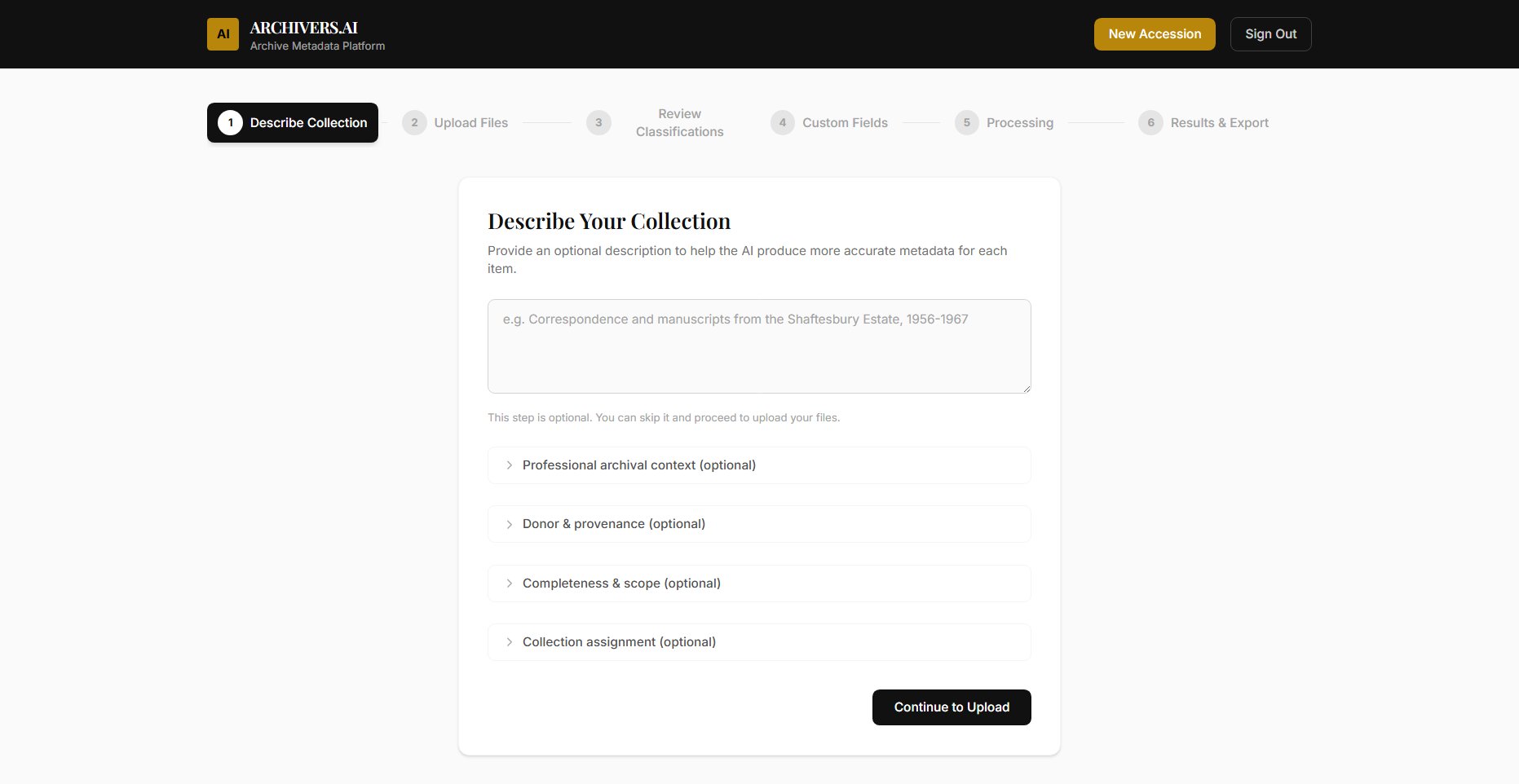
For many heritage projects, creating ISAD(G)-compliant descriptions is the most time-consuming part of cataloguing. Archivers.ai generates ISAD(G)-compliant hierarchical descriptions automatically. When you set up a collection, you describe the archival context — the repository, the donor, the provenance, the date range — and the platform’s AI maps each digitised item into the correct level of the archival hierarchy.
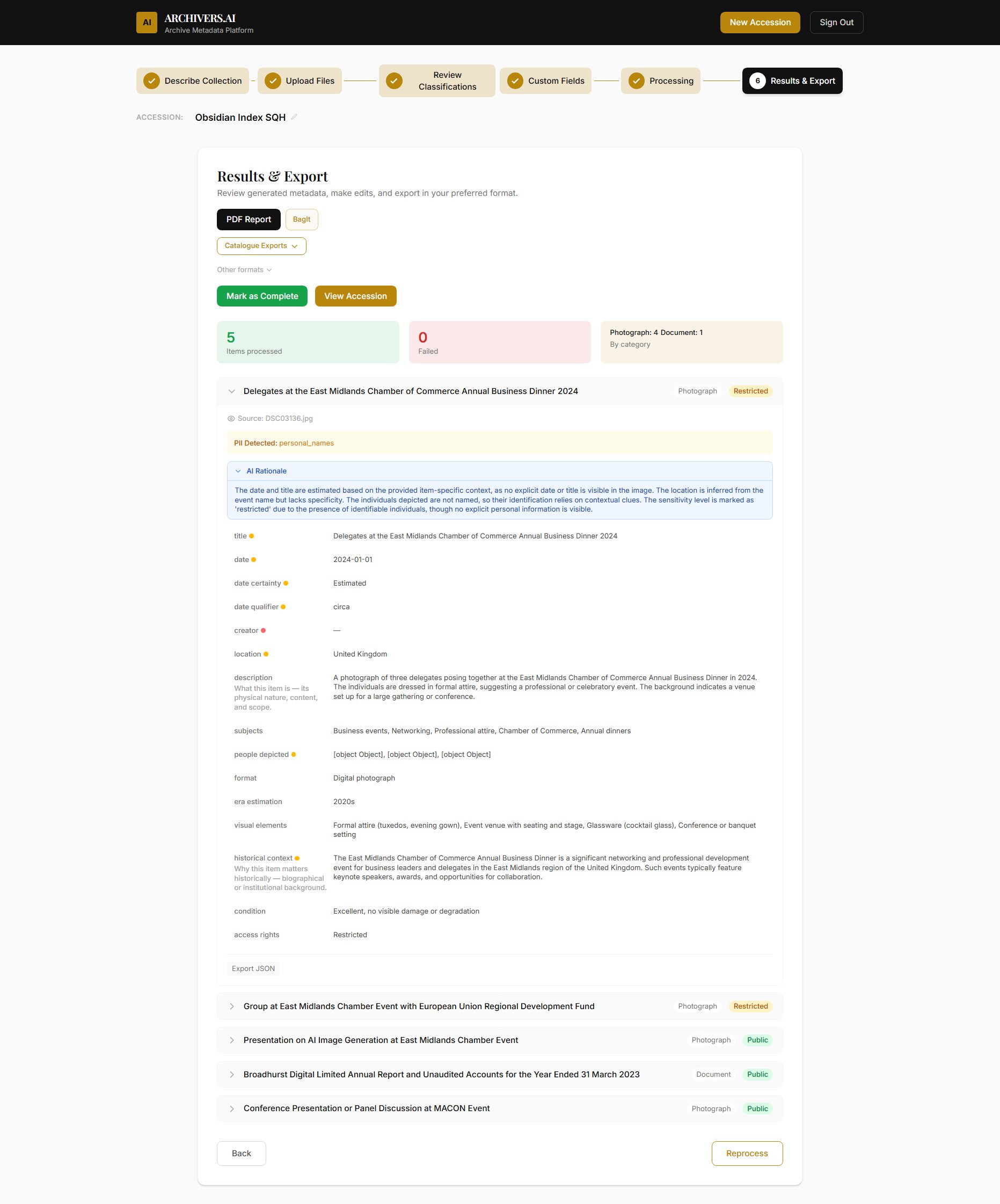
The AI does not work unsupervised. Every metadata field cites the evidence it was drawn from, or says plainly that it has none, and archivists review, edit and accept each record before it is finalised. The platform suggests; the human decides. This human-in-the-loop approach is essential for maintaining the archival cataloguing standards that NLHF assessors expect to see.
EAD3: enabling global discovery and interoperability
EAD3 — Encoded Archival Description, version 3 — is the machine-readable, XML-based counterpart to ISAD(G). For a deeper technical walkthrough of how EAD works in practice, see our EAD metadata standard explained. If ISAD(G) defines what you describe and how you structure it, EAD3 defines how you share it with the wider archival world. It is the primary tool for meeting the NLHF goal of “opening up access via the web” and encouraging “global learning.”
Why EAD3 matters for your bid
The strategic benefits of EAD3 go directly to the heart of NLHF requirements:
- Vendor independence. EAD3 is a non-proprietary XML standard. Even if your software provider ceases operations, your archival descriptions remain readable and migratable. This is precisely the kind of “Organisational Sustainability” the Fund rewards.
- Interoperability. EAD3 finding aids can be ingested by data aggregators like Europeana, the Archives Hub, and Wikimedia Commons — transforming your project from a local resource into a globally discoverable one.
- Preservation and the 3-2-1 rule. EAD3 supports the best-practice approach of maintaining 3 copies on 2 media types with 1 offsite location. Its lightweight, standardised format makes it ideal for long-term digital backups.
EAD3 is the bridge between a community archive and “global learning.” Like the People’s Collection Wales model, using EAD3 allows you to demonstrate to the NLHF that your digital outputs will have a life well beyond your local servers, reaching researchers and underserved communities worldwide.
The practical problem: EAD3 is difficult to produce manually
Here is the challenge that many heritage projects underestimate. EAD3 is an XML standard, and producing valid EAD3 by hand requires considerable technical skill. Hand-coding XML is error-prone, time-consuming, and entirely impractical for volunteer-led community archives. Even professional archivists rarely write raw XML — they rely on software to generate it.
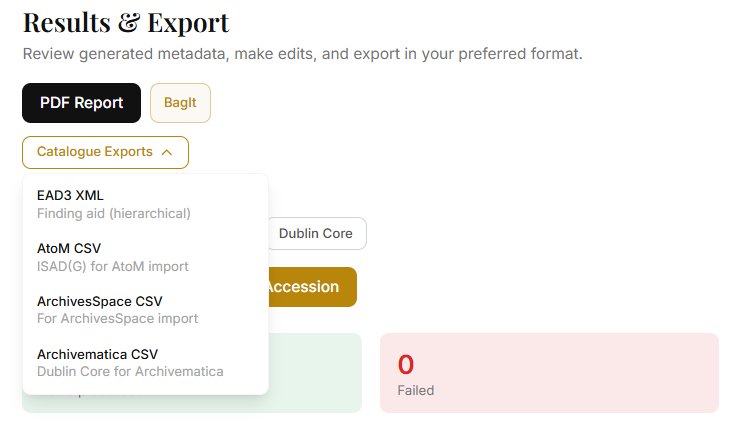
Archivers.ai solves this directly. The platform exports to EAD3 XML with a single click — no manual XML encoding needed. The resulting file is ready for ingest into the Archives Hub, AtoM, or ArchivesSpace without further processing.
This is not a minor convenience. For many NLHF-funded projects, especially those involving community archives and volunteer cataloguers, the ability to produce standards-aligned EAD3 without XML expertise removes one of the most significant technical barriers to meeting the Fund’s interoperability requirements.
Dublin Core: simplicity for maximum reach and inclusion
Dublin Core is a “web-native” metadata standard designed for broad discovery rather than deep archival description. Where ISAD(G) and EAD3 serve the archival community, Dublin Core serves the wider web — search engines, digital libraries, cultural heritage aggregators, and the general public.
For NLHF bids, Dublin Core is the most effective tool for demonstrating the “Inclusion, Access, and Participation” principle. Its simplicity makes it accessible to non-specialists, which is precisely the point.
The core fields that matter
Dublin Core uses a flat set of metadata fields rather than a hierarchy. The fields most relevant to heritage projects are:
- Creator: Essential for attribution and provenance.
- Date: Crucial for chronological discovery and historical context.
- Place (Coverage): Vital for local community engagement and geographic search.
- Subject: Enables thematic discovery across collections.
- Rights: Mandatory for demonstrating “Openness” to NLHF assessors.
Dublin Core and community participation
Dublin Core’s simplicity is its greatest strength for projects that involve co-creation with volunteers and community groups. By using a standard that non-experts can understand and contribute to, you empower “ordinary people” to participate in cataloguing their own family memories, local history, and community heritage. This democratised approach to digitisation directly supports the NLHF’s mandate to remove barriers to heritage participation.
Archivers.ai includes Dublin Core export alongside its archival formats. The platform’s AI extracts Creator, Date, Place, Subject, and Rights automatically from the digitised content, making Dublin Core cataloguing accessible to volunteers and non-experts who would struggle with more technical standards. Volunteers upload material, the AI suggests metadata, and a supervising archivist reviews the results — a workflow that scales community participation without sacrificing accuracy.
How the three standards work together
These three standards are not competitors. They serve different purposes within the same project:
| Standard | Purpose | Audience | Complexity |
|---|---|---|---|
| ISAD(G) | Deep archival description with provenance | Archivists, researchers | High |
| EAD3 | Machine-readable exchange and discovery | Archives Hub, AtoM, aggregators | Technical (XML) |
| Dublin Core | Broad web discovery and inclusion | General public, search engines | Low |
A well-planned NLHF project uses all three. ISAD(G) provides the intellectual foundation. EAD3 encodes that description for interoperability. Dublin Core makes the collection discoverable to the widest possible audience. Together, they satisfy every dimension of the Fund’s “Available, Accessible, and Open” requirements.
With Archivers.ai, you catalogue once and export to all three formats. The platform holds a single authoritative description for each item and generates the appropriate output for each standard — eliminating the need to maintain parallel metadata records or re-key information across different systems.
The “No New Rights” mandate and open metadata
NLHF policy on intellectual property is unambiguous. All metadata and code produced with grant funding must be shared under a Creative Commons 0 1.0 Universal Public Domain Dedication (CC0 1.0). For reproductions of public domain works, no new rights should arise. You cannot claim copyright on a digital scan of an out-of-copyright 19th-century map.
This “no rights reserved” approach is a non-negotiable condition of funding, and it has practical implications for your metadata workflow. Every export format, every field label, every description you produce must be compatible with CC0 dedication.
Archivers.ai metadata exports default to open formats suitable for CC0 dedication. Digital reproductions maintain their public domain status through the platform — the system does not introduce proprietary locks or format restrictions that would conflict with the Fund’s openness requirements. When you export to EAD3, Dublin Core, or CSV, the output is yours to share, publish, and deposit without restriction.
Implementation: budgeting for metadata without a consultancy budget
Planning for metadata must begin in the “Digitisation Project Planner” phase of your bid. To satisfy the “Organisational Sustainability” principle, your budget must reflect the true cost of making digital assets available, accessible, and open. This is where many bids come unstuck — either by underestimating the cost of metadata work or by overcomplicating it with expensive consultancy line items.
The traditional approach (and its costs)
Historically, heritage projects have budgeted for metadata under several headings:
- Skills and training: Costs for upskilling the team or volunteers in ISAD(G) or Dublin Core entry.
- Professional fees (rights clearance): Budget for experts to clear third-party rights and manage special category data such as oral histories.
- Metadata enrichment: Fees for consultants to transform ambiguous records into searchable, standards-aligned assets.
- Software and persistent identifiers: Subscriptions for platforms that support machine-readable formats and ensure 5–20 year availability.
These costs add up quickly. A metadata consultancy engagement for a medium-sized heritage project can easily run to several thousand pounds — money that could otherwise fund digitisation, community engagement, or conservation work.
A more efficient approach
Archivers.ai eliminates the need for separate metadata consultancy by combining cataloguing, standards compliance, and export in a single platform. Instead of budgeting separately for “Skills and Training in ISAD(G),” “Metadata Enrichment experts,” and bespoke export development, organisations can budget for an Archivers.ai subscription that handles all three standards from a single workflow.
The pricing is straightforward, and published transparently on the pricing page:
- A free tier — ideal for small volunteer-led projects testing their workflow.
- Paid plans sized for small organisations: Full access including audio and video cataloguing and all export formats (EAD3, Dublin Core, AtoM CSV, ArchivesSpace CSV).
For a 12-month NLHF-funded digitisation project, that represents a single predictable software subscription — a fraction of what a metadata consultancy engagement would cost, and a line item that NLHF assessors can easily justify under “Software and Persistent Identifiers.”
The remaining budget that would have gone to metadata consultancy can be redirected to rights clearance (which still requires human expertise), community engagement activities, or additional digitisation capacity.
Practical steps for your NLHF bid
If you are preparing a heritage bid and want to get your metadata strategy right from the outset, here is a practical checklist:
-
Choose your standards early. Decide which combination of ISAD(G), EAD3, and Dublin Core your project requires. For most archival projects, the answer is all three.
-
Map standards to NLHF principles. In your bid narrative, explicitly link each standard to the relevant investment principle — ISAD(G) to “Saving Heritage,” EAD3 to “Organisational Sustainability,” Dublin Core to “Inclusion, Access, and Participation.”
-
Budget realistically. Include line items for software, training, and rights clearance. Do not assume volunteers can produce standards-aligned metadata without tooling and supervision. For practical cost breakdowns, see our guide to budgeting for digitisation in your NLHF bid.
-
Plan for interoperability from day one. Your metadata must be exportable to open formats. If your chosen platform cannot produce EAD3 or Dublin Core natively, you will need to budget for conversion — or choose a platform that handles it. See our full list of supported export formats for details.
-
Document your metadata policy. NLHF assessors want to see that you have thought through how metadata will be created, reviewed, and maintained. A short metadata policy document strengthens your bid considerably.
-
Use the Project Enquiry Service. The NLHF encourages applicants to get early feedback on project ideas. Raise your metadata strategy explicitly — it signals that you understand the digital requirements.
Conclusion: standards are the foundation, not the ceiling
Selecting the correct metadata standards is a strategic decision that fulfils the NLHF mandate to “conserve and value heritage for now and the future.” ISAD(G) provides the depth for archival integrity. EAD3 provides the exchange format for global reach. Dublin Core provides the simplicity for community participation.
The challenge for most heritage projects is not understanding why these standards matter — it is implementing them without specialist technical skills or inflated budgets. That is precisely the gap that Archivers.ai is designed to fill: catalogue once, export to every standard, and keep the archivist in control throughout.
Standardising your metadata today is the only way to ensure your heritage is discoverable, accessible, and valued for the next 20 years.
Ready to see how Archivers.ai handles metadata standards for heritage projects? Discuss your NLHF project or start free and test the full workflow, from digitisation through to EAD3 and Dublin Core export.