
The National Lottery Heritage Fund (NLHF) is the largest dedicated funder of heritage projects in the UK, distributing hundreds of millions of pounds annually. Its current strategy, Heritage 2033, has shifted the emphasis from what organisations want to preserve to what communities need — and applications that fail to demonstrate that distinction are unlikely to succeed.
For archive and digitisation projects specifically, the NLHF applies a detailed set of digital requirements that go well beyond scanning and uploading. This guide covers the full scope of what the fund expects: the investment principles that frame every decision, the digital good practice standards you must meet, the 10-step digitisation framework the fund recommends, and the licensing rules that govern your outputs.
If you are preparing a bid — or helping a community archive or museum prepare one — this is the reference you need. You may also find our dedicated heritage funding resource page useful as a companion to this guide.
The four investment principles
Every NLHF application is assessed against four interlinked principles. You do not need to address all four equally, but your project must clearly align with each one to some degree.
Saving Heritage — Conserving and valuing heritage at risk of loss, damage, or being forgotten. For digitisation projects, this means demonstrating that your collection faces a genuine threat — physical deterioration, single-point-of-failure storage, or lack of cataloguing that effectively renders material invisible.
Protecting the Environment — Reducing adverse environmental impacts and helping heritage adapt to climate change. Digitisation projects can address this through efficient workflows, local suppliers, and reduced need for physical handling of fragile originals.
Inclusion, Access, and Participation — This is the principle the NLHF weights most heavily. The fund’s primary outcome is that a wider range of people will be involved in heritage. Your project must show how it will remove barriers for underserved communities and involve diverse audiences — not just as passive consumers, but as active participants and volunteers.
Organisational Sustainability — Strengthening your organisation’s long-term future through improved governance, digital skills, or commercial capacity. A digitisation project that builds lasting internal capability scores higher than one dependent on external consultants who leave when the grant ends.
For museum directors and heads of collections, these principles shape everything from how you frame the initial bid to how you report outcomes at project close.
What the NLHF means by “digital outputs”
The fund defines “digital outputs” broadly: anything created with project funding in a digital format to provide access to or engagement with heritage. That includes databases, websites, 3D models, software, audio, video, and digitised collections.
All digital outputs must meet three non-negotiable standards.
1. Availability
Your outputs must remain publicly accessible for a set period after project completion:
- Grants of £10,000 to £250,000: minimum 5 years
- Grants over £250,000: minimum 20 years
This has direct implications for your technology choices. Platforms that could disappear, subscription services you may not be able to afford long-term, or bespoke systems with no migration path are all risks that reviewers will flag.
2. Accessibility
Websites and digital content must meet recognised web accessibility standards:
- Grants of £10,000 to £250,000: W3C Single A
- Grants over £250,000: W3C Double A (WCAG 2.1 AA)
This applies to your public-facing outputs — the platforms where your digitised collections are published and discovered.
3. Openness
Unless a recognised exception applies, your outputs must be shared under an open licence. Exceptions include materials depicting minors, sensitive personal data, and content involving adults at risk. Everything else defaults to open.
These three pillars are not aspirational guidance — they are conditions of your grant. Fail to meet them and you risk clawback.
Licensing standards you must follow
The NLHF is specific about which licences apply to different types of output.
Content (images, text, audio, video): Creative Commons Attribution 4.0 International (CC BY 4.0). This allows anyone to share and adapt your work for any purpose, including commercial, provided they credit the source.
Metadata and code: Creative Commons 0 1.0 Universal Public Domain Dedication (CC0 1.0). Your catalogue records, descriptive metadata, and any software code must be released into the public domain with no restrictions.
Public domain works: Where your project digitises materials already in the public domain, no new rights should be claimed from the reproduction. Digital copies should be marked CC0 1.0.
This licensing framework has practical implications for how you build your cataloguing workflow. Your metadata needs to be structured for CC0 dedication from the start — not retrofitted later. For a detailed look at the metadata standards the NLHF expects, see our guide to NLHF metadata standards including ISAD(G), EAD3, and Dublin Core. Archivers.ai metadata exports are designed with CC0 1.0 dedication in mind, and the platform’s sensitivity levels help you identify items that may qualify for exceptions before you publish.
The 10-step digitisation framework
The NLHF recommends a structured lifecycle for digitisation projects. This is not a rigid sequence — steps overlap and iterate — but it provides the framework against which your project plan will be assessed.
Step 1: Plan
Define your objectives, identify your target audiences, and assess your current resources. What are you digitising, why does it matter, and who will use it?
This is where you establish scope. Archivers.ai supports all major collection types — documents, photographs, artefacts, audio, and video — which means you can plan a single workflow for mixed collections rather than juggling multiple tools and processes. For community archives working with limited resources, that simplification is significant.
Step 2: Clear rights
Audit your materials to categorise what can be published under CC BY 4.0 or CC0 1.0. Identify orphan works, materials with unclear provenance, and items requiring sensitivity review. This step is often underestimated — and the NLHF knows it.
Step 3: Organise your team
Allocate responsibilities and identify training needs. The fund favours projects that build internal capability rather than relying entirely on external consultants. Factor in volunteer coordination, as the inclusion principle rewards meaningful community participation.
Step 4: Select equipment
Choose between renting, buying, or using existing tools. The NLHF recognises that smartphones can produce high-quality capture — the Folger Shakespeare Library has used them successfully for high-resolution detail images. Match your equipment to your collection type and budget rather than defaulting to the most expensive option.
Step 5: Digitise
Carry out the capture of images, sound, or 3D objects according to the standards you defined in your project plan. This is the production phase — and it generates the raw digital files that need to move into cataloguing.
Once capture is complete, Archivers.ai is where you upload your digitised files for AI-assisted cataloguing. Rather than processing items manually one by one, the platform analyses your uploads and generates structured catalogue records — turning a scanning backlog into a described, searchable collection.
Step 6: Edit
Colour correction, noise removal, cropping, and resizing for web publication. This step prepares your master files and derivatives for the cataloguing and publication stages that follow.
Step 7: Metadata and rights
This is where many digitisation projects stall. Cataloguing is labour-intensive, and inconsistent metadata undermines everything that follows — from discoverability to long-term preservation.
Archivers.ai addresses this directly. The platform generates structured metadata with ISAD(G) compliance, sensitivity flagging, and consistent cataloguing templates. Every record cites its evidence field by field so your archivists can review AI-generated descriptions against the original material — a human-in-the-loop workflow that maintains professional standards while dramatically reducing the time per item.
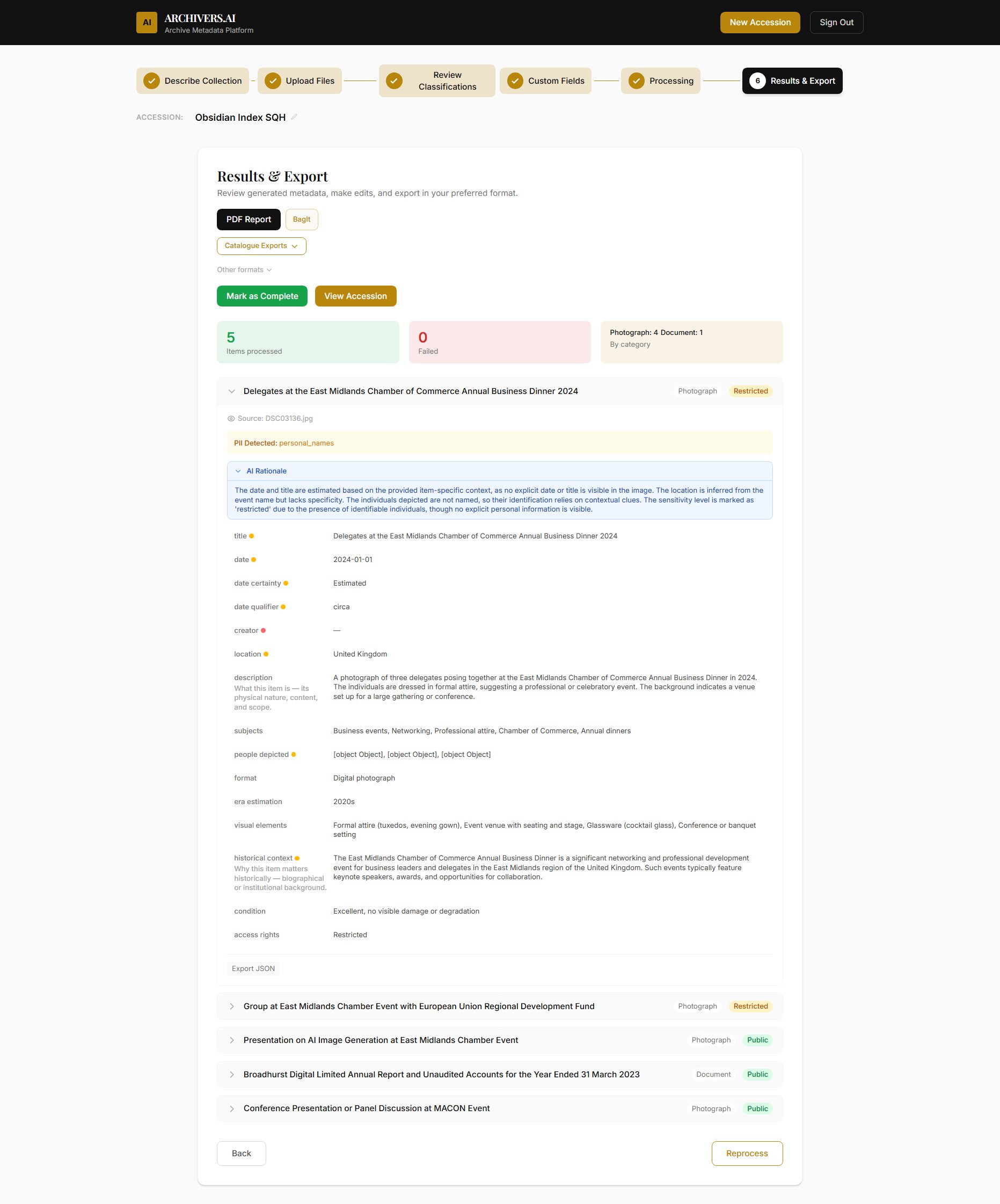
For NLHF projects, this step must also apply the correct licensing metadata. Each item needs a clear rights statement, and your cataloguing system must distinguish between CC BY content and items qualifying for exceptions.
Step 8: Store
Follow the 3-2-1 rule: three copies of every file, on two different media types, with one copy stored offsite. Your project plan should specify where each copy lives and how migration will be handled when storage media reach end of life.
Our guide to digital archive backup and storage covers this in detail.
Step 9: Publish
Select platforms based on user reach and accessibility compliance. The NLHF mentions Wikimedia Commons, Flickr Pro, and Omeka as examples — but the key requirement is that your chosen platform meets the availability and accessibility standards above.
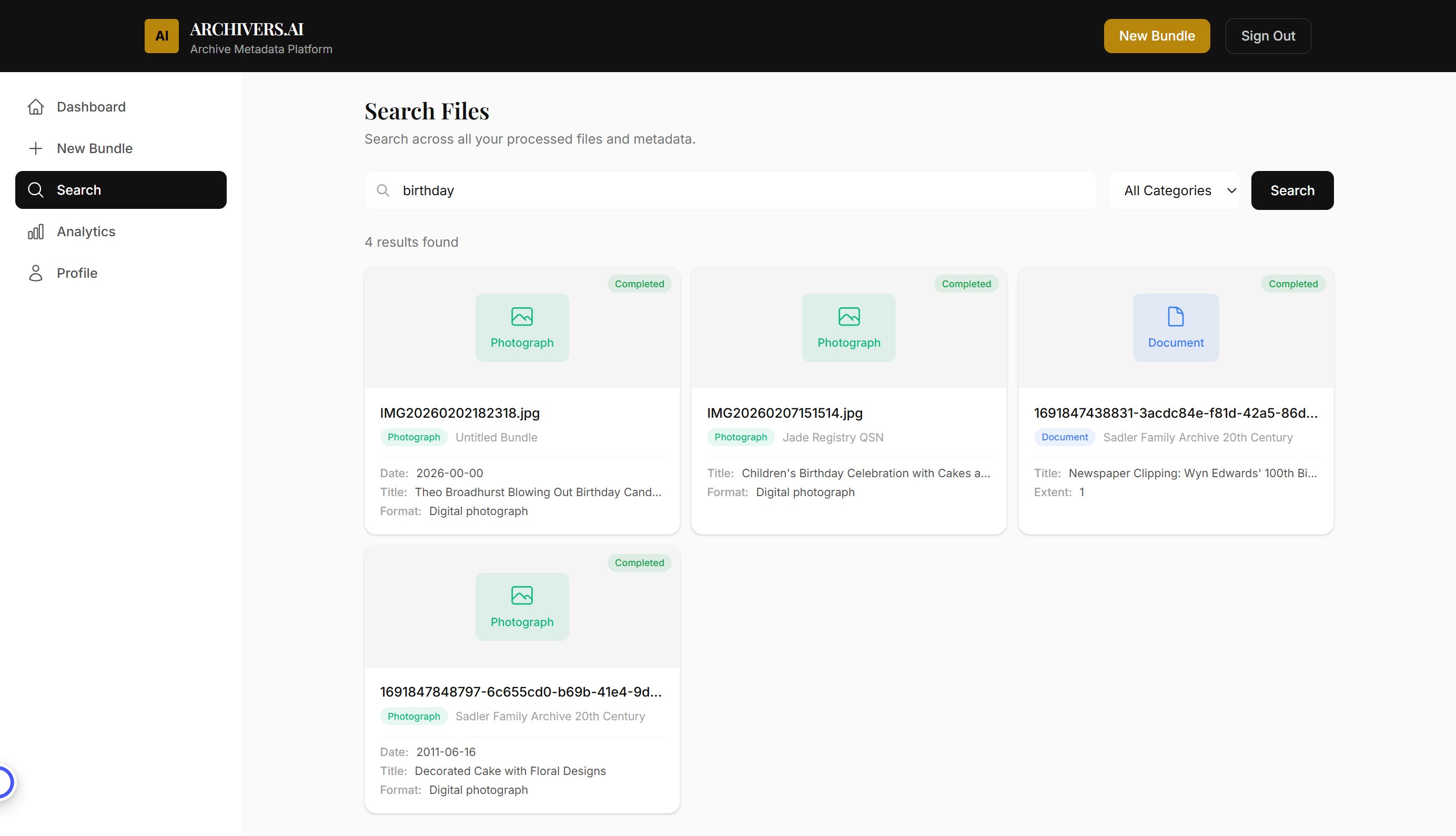
Archivers.ai’s Research and Explore AI interface provides a ChatGPT-style way for the public to search and discover your catalogued collections. Users ask questions in natural language and receive answers drawn directly from your catalogue records and digitised materials — making your collection genuinely accessible to audiences who would never navigate a traditional archival finding aid.
Step 10: Deposit
Archive your materials in repositories that ensure long-term access beyond your own organisation’s lifespan. The NLHF references the UK Web Archive and similar institutional repositories.
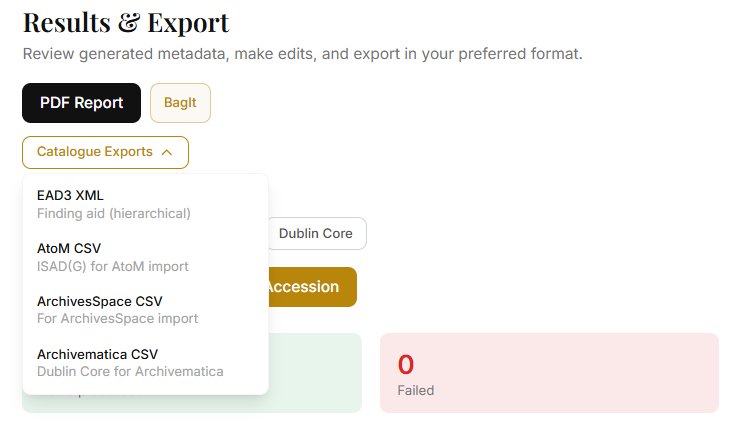
Archivers.ai’s BagIt export creates preservation-ready packages with PREMIS metadata — the format expected by digital preservation repositories. EAD3 export feeds directly into aggregate discovery portals like the National Archives’ Discovery service, Archives Hub, and platforms such as AtoM and ArchivesSpace. This means your project’s outputs are ready for deposit without manual reformatting.
Developing a successful bid
Securing NLHF funding requires a shift from technical focus to community impact. The strongest bids share several characteristics.
Start with consultation, not technology
The NLHF requires evidence of need, not want. This means consulting existing and potential new audiences before you write your application. What do researchers, community members, and educators actually want from your collection? What barriers prevent them from using it today?
Approach the NLHF early. Priority areas vary by region, and aligning your project goals with local priorities increases success rates significantly.
Build partnerships beyond the sector
Bids are strengthened by collaborating with groups not traditionally engaged with heritage — youth organisations, local employment programmes, care leavers’ groups, and community health initiatives. The inclusion principle is not a box-ticking exercise; it shapes how applications are scored.
Get the mandatory documents right
Applications are delayed or rejected outright if they lack:
- Governing documents (constitution or articles of association)
- Audited accounts, or three months of bank statements for new groups
- A detailed project plan with timeline, milestones, and risk register
- A budget that accounts for “full cost recovery” — our guide to budgeting for digitisation in an NLHF bid covers this in depth — including staff time, evaluation, and a 5-10% contingency
Your vision statement is limited to 150 words. Use it to describe the project’s legacy, not its logistics.
AI in heritage projects: what the NLHF expects
The NLHF acknowledges that organisations may use AI tools to assist with applications and project delivery, but it issues specific warnings that applicants should take seriously.
Generic content fails. AI tools like ChatGPT produce plausible but generic text that rarely captures the specific story of a local heritage site. Fund reviewers read dozens of applications per cycle — they recognise generic language immediately.
You are legally responsible. Any misleading information in your application is your responsibility, regardless of whether an AI generated it. Every claim must be verified.
Data privacy matters. Avoid inputting personal or commercially sensitive data into free AI tools. This is particularly relevant for archives holding personal records, oral histories, or materials subject to data protection legislation.
Environmental considerations. The NLHF notes that AI queries consume significantly more energy than standard searches — a tension with the “Protecting the Environment” principle.
These concerns are valid, but they apply primarily to general-purpose AI tools being used for tasks they were not designed for. Archivers.ai is purpose-built for archive cataloguing, not a general chatbot repurposed for heritage work. The platform includes human-in-the-loop review at every stage: AI-generated descriptions are presented with their evidence, flagged for sensitivity, and require archivist approval before they become part of your catalogue. This directly addresses the NLHF’s concerns about accuracy and privacy — your team retains full editorial control while benefiting from AI-assisted efficiency. For more on why this approach matters to funders, see our guide to human-in-the-loop AI and what heritage funders expect.
For a deeper look at how AI fits into professional archival practice, see our guide to AI for archives.
Low-cost strategies the NLHF supports
Not every digitisation project needs a six-figure budget. The fund explicitly recognises several low-cost approaches:
- Smartphone capture — appropriate for many collection types and proven in professional settings
- Crowdsourcing and volunteers — engaging community members to source, digitise, and interpret collections, which also supports the inclusion principle
- Free platforms — Wikimedia Commons for public domain materials extends reach without hosting costs
- Digitisation on demand — charging small service fees for new image creation to fund ongoing work
These strategies pair well with AI-assisted cataloguing. Volunteer-led digitisation projects often struggle with metadata consistency — different volunteers describe the same types of material in different ways. A platform like Archivers.ai applies consistent cataloguing templates regardless of who uploaded the material, giving community archives professional-grade metadata from volunteer-driven workflows.
Bringing it together: from application to deposit
A successful NLHF digitisation project is not a single event — it is a structured lifecycle that begins with community consultation and ends with materials deposited in preservation repositories. Our complete guide to digitising an archive walks through the full process from start to finish. At every stage, the fund is looking for evidence that you understand the standards, have a credible plan, and will deliver outputs that remain accessible long after the grant period ends.
The requirements are demanding, but they exist for good reason: to ensure that public funding creates lasting public value. Organisations that invest time in understanding these standards before they apply — and that choose tools designed to meet them — put themselves in the strongest possible position.
If you are preparing an NLHF application and want to see how Archivers.ai handles cataloguing, metadata, and preservation-ready exports, discuss your NLHF project or start free and run a pilot with your own collection. The evidence you generate becomes part of your application.