
A digitisation project that stalls halfway through is worse than one that never starts. The equipment sits idle, the half-processed collection is neither discoverable nor preserved, and the funder remembers your organisation as a risk. Every heritage professional who has seen this happen knows the cause is rarely technical — it is strategic. The project lacked a lifecycle plan.
This article sets out a practical roadmap for planning and delivering a heritage digitisation project from initial vision through to long-term deposit and sustainability. It draws on the National Lottery Heritage Fund (NLHF) framework — specifically the digital good practice guidance — and maps each stage to the tools, standards, and decisions that determine whether a project succeeds or stalls.
Whether you are a community archive preparing your first bid or a museum director building a strategic case for investment, the lifecycle approach ensures that every decision you make early on supports the outcomes funders expect to see at the end.
Start with the vision, not the scanner
It is tempting to begin a digitisation project by talking about equipment, file formats, and scanning resolutions. But the NLHF framework starts somewhere else entirely: the vision. Specifically, four interconnected pillars that underpin every successful funded project.
The Idea — the strategic “why.” A clear, well-articulated idea acts as the anchor for a successful funding application. It must demonstrate that the project is a fundamental necessity for your institution’s growth, not a peripheral activity. Reviewers want to see that digitisation serves a purpose: safeguarding heritage at risk, opening access to underserved communities, or enabling new forms of research.
The Materials — what you hold and what it demands. Projects must distinguish between documents, photographs, film (including microfilm and microfiche), audio-visual recordings, bound volumes, and three-dimensional objects. Each category carries distinct technical specifications, handling requirements, and cost profiles.
The Team — who will do the work, and what gaps need filling. A comprehensive identification of staff, partners, and volunteers allows for an accurate assessment of capacity and training needs.
The Audiences — the “so what?” factor. Identifying your target audiences is not a secondary task; it is a technical prerequisite. The specific needs of local communities, researchers, or global audiences dictate the resolution standards, metadata complexity, and publication platforms your project requires.
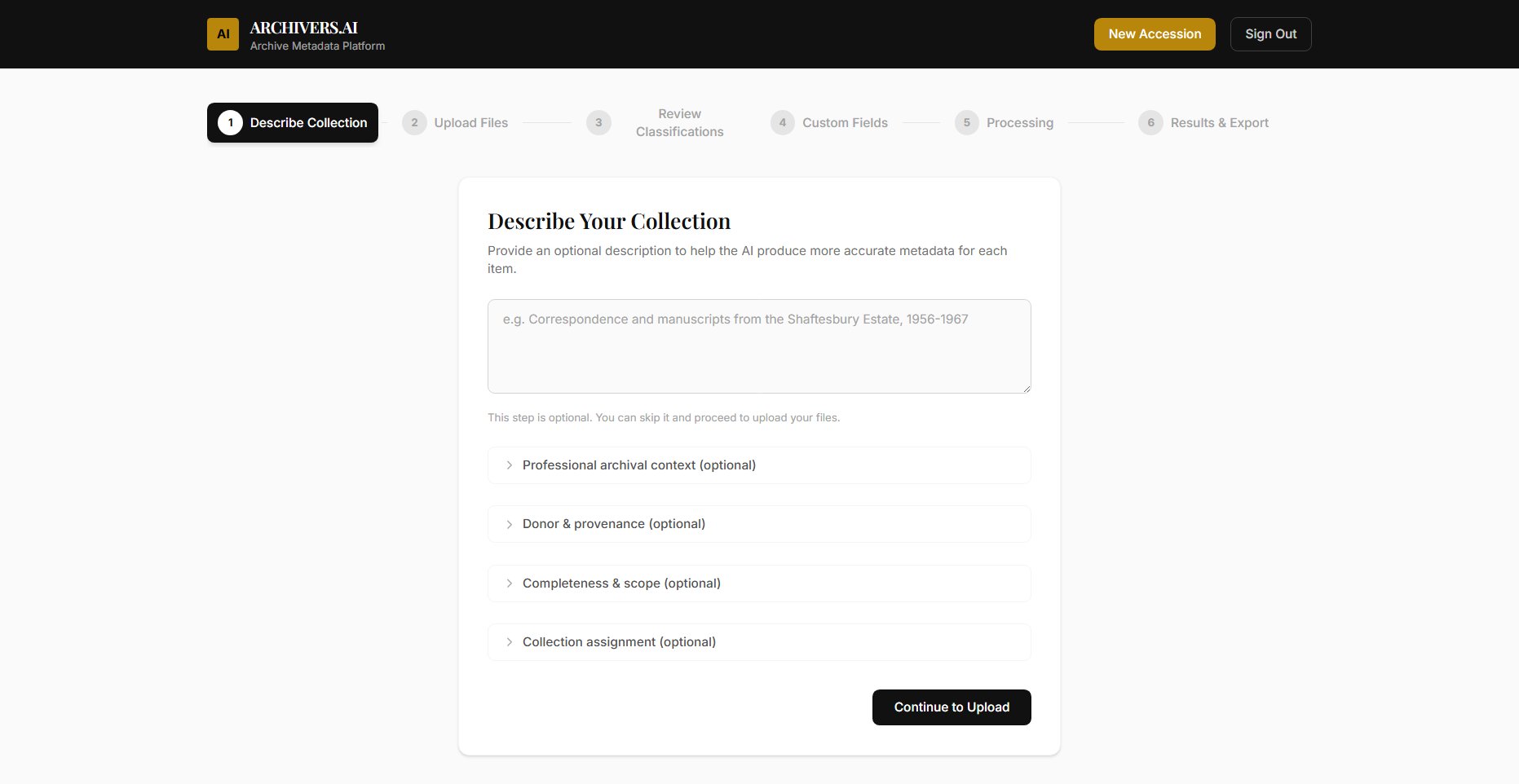
Archivers.ai supports all the material types listed above — documents, photographs, film, AV, and 3D objects. The platform’s accession wizard guides users through describing their collection context step by step: repository name, collection title, donor details, and provenance narrative. This maps directly to the NLHF’s four-pillar framework, giving you a structured starting point before you write a word of your application.
Audit your resources before you bid
Before initiating a formal bid, project leads must perform a rigorous audit of internal capabilities. This is where underprepared applications fall apart — not because the collection is insignificant, but because the organisation cannot demonstrate it has the skills and infrastructure to deliver.
The NLHF expects you to account for competencies across several categories:
- Project management and governance — who leads, who reports, what are the decision-making structures
- Rights clearance and legal permissions — do you know what you can digitise, share, and publish?
- Technical digitisation and equipment operation — can your team operate the hardware, or will you need training or outsourcing?
- Cataloguing and archival standards — can you produce metadata that meets professional expectations?
- Data entry and management — who populates the catalogue records, and how?
- Software proficiency — what tools will your team use, and are they trained on them?
- Publicity and engagement — how will you tell the public what you have done?
This is a long list of specialist skills, and for many organisations — particularly smaller archives and volunteer-led groups — it represents a genuine barrier. This is where the right technology makes a measurable difference. Archivers.ai reduces the specialist expertise required: instead of needing trained staff across cataloguing standards, data entry, and software proficiency, the platform’s AI handles metadata generation, consistent formatting, and archival export standards. Your team can focus on what humans do best — review, contextualisation, and community engagement.
You also need to assess financial readiness: existing funds available for pilot phases, partner contributions (cash or in-kind), and contingency funds of 5 to 10 per cent of the total budget. Our guide to budgeting for digitisation in an NLHF bid breaks down each cost category in detail.
Align with what the NLHF actually funds
The NLHF operates on an outcomes-based model. Understanding the four investment principles is not optional — it is the lens through which every element of your application will be assessed.
-
Saving Heritage — the primary focus is on heritage at risk. This includes heritage in poor condition, at risk of loss or damage, or simply at risk of being forgotten. If your collection is deteriorating, inaccessible, or uncatalogued, this is the principle that justifies your project.
-
Protecting the Environment — projects must demonstrate a reduced environmental footprint. Prioritising local suppliers, minimising travel through digital workflows, and choosing sustainable infrastructure all count here.
-
Inclusion, Access, and Participation — this is the non-negotiable metric. Success is defined by the outcome: “A wider range of people will be involved in heritage.” Your digitisation project must widen access, not simply reproduce what is already available to existing users.
-
Organisational Sustainability — projects must develop digital and commercial skills to ensure the institution is a capable, long-term steward. Funders are investing in capacity, not dependency.
Grant tiers and what they require
The NLHF operates two main grant tiers, and the compliance expectations scale accordingly:
| Requirement | £10,000 – £250,000 | Over £250,000 |
|---|---|---|
| Output availability (£10k–£250k grants) | 5 years minimum | 20 years minimum |
| Accessibility standard | W3C Single A | W3C Double A |
| Payment structure | 50% upfront, 30% mid-project, 20% final | Drawdown based on evidenced spend |
For grants over £250,000, the 20-year availability commitment is substantial. Your sustainability plan must be credible over that timeframe — which means the tools, formats, and infrastructure you choose at the start have long-term consequences.
To pass the initial check stage, your organisation’s governing documents must include a non-profit distribution statement and a dissolution clause ensuring assets transfer to another non-profit. The NLHF cannot fund statutory responsibilities, activities that have already occurred, or projects promoting specific political or faith-based beliefs.
The ten-step operational lifecycle
Maintaining data integrity and project momentum requires a structured approach. The following ten steps ensure that digital assets are technically sound, legally sustainable, and genuinely discoverable.
Steps 1–3: Foundation
Step 1 — Plan. Define objectives and identify the specific public you intend to reach. This step locks in your vision and prevents scope creep later.
Step 2 — Rights audit. Categorise materials into five groups: no permissions needed; permissions given; permissions can be sought; unknown status (orphan works); and publication not possible. Orphan works cannot be shared under an open licence and must be published with an “Unknown Rightsholder” label. Getting this wrong can derail an entire project.
Step 3 — Organise the team. Allocate responsibilities and plan for upskilling to reduce long-term outsourcing costs. If you are relying on volunteers, build in training time and supervision.
Steps 4–6: Production
Step 4 — Organise equipment. Evaluate the buying versus renting trade-off. Strategic pilots can use existing hardware — including smartphones — to prove concept before committing to expensive scanners. See our guide to choosing document scanning equipment for detailed advice.
Step 5 — Digitise. Execute according to technical specifications: TIFF for archival images, WAV for audio, PDF/A for documents. Consistency here is non-negotiable. Our complete guide to digitising an archive walks through the full process.
Step 6 — Edit. Resize, reformat, and compress assets for web use. Professional or open-source software such as GIMP for images and Audacity for audio will handle most requirements. This step produces the access copies that your audiences will actually use.
Steps 7–10: Discovery, access, and preservation
This is where many projects lose momentum — the scanning is done, but the collection remains invisible. Steps 7 through 10 are where digitisation becomes a genuinely useful public resource, and this is where Archivers.ai transforms the workflow.
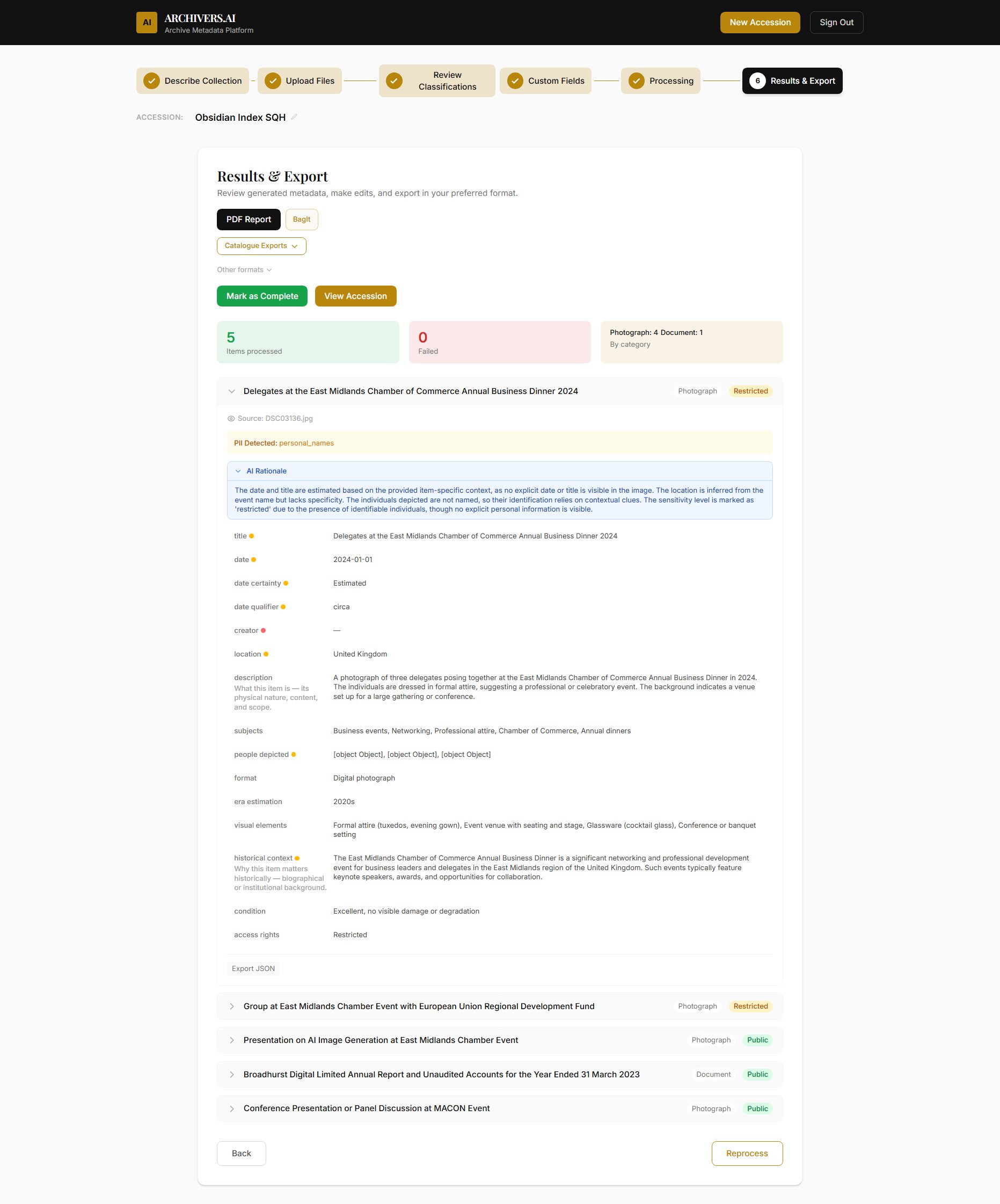
Step 7 — Metadata enrichment. The core principle is simple: collect information as close to the source as possible, using standard fields and consistent formats. In practice, this is the most time-consuming step in any digitisation project. Manual metadata creation for hundreds or thousands of items can take months of staff time.
Archivers.ai automates this step. The platform’s AI examines each digitised item and extracts rich, structured metadata automatically — descriptions, dates, subjects, named entities — using standard fields consistently across the entire collection. For a deeper look at which metadata standards the NLHF expects, see our guide to NLHF metadata standards including ISAD(G), EAD3, and Dublin Core. What would take a team weeks of manual data entry is completed in minutes, with human review built into the workflow.
Step 8 — Storage (the 3-2-1 rule). Maintain three copies, on two media types (for example, hard drive and cloud), with one backup stored offsite. This is non-negotiable for any funded project and should be reflected in your budget. For a deeper look at storage strategy, see our guide to digital archive backup and storage.
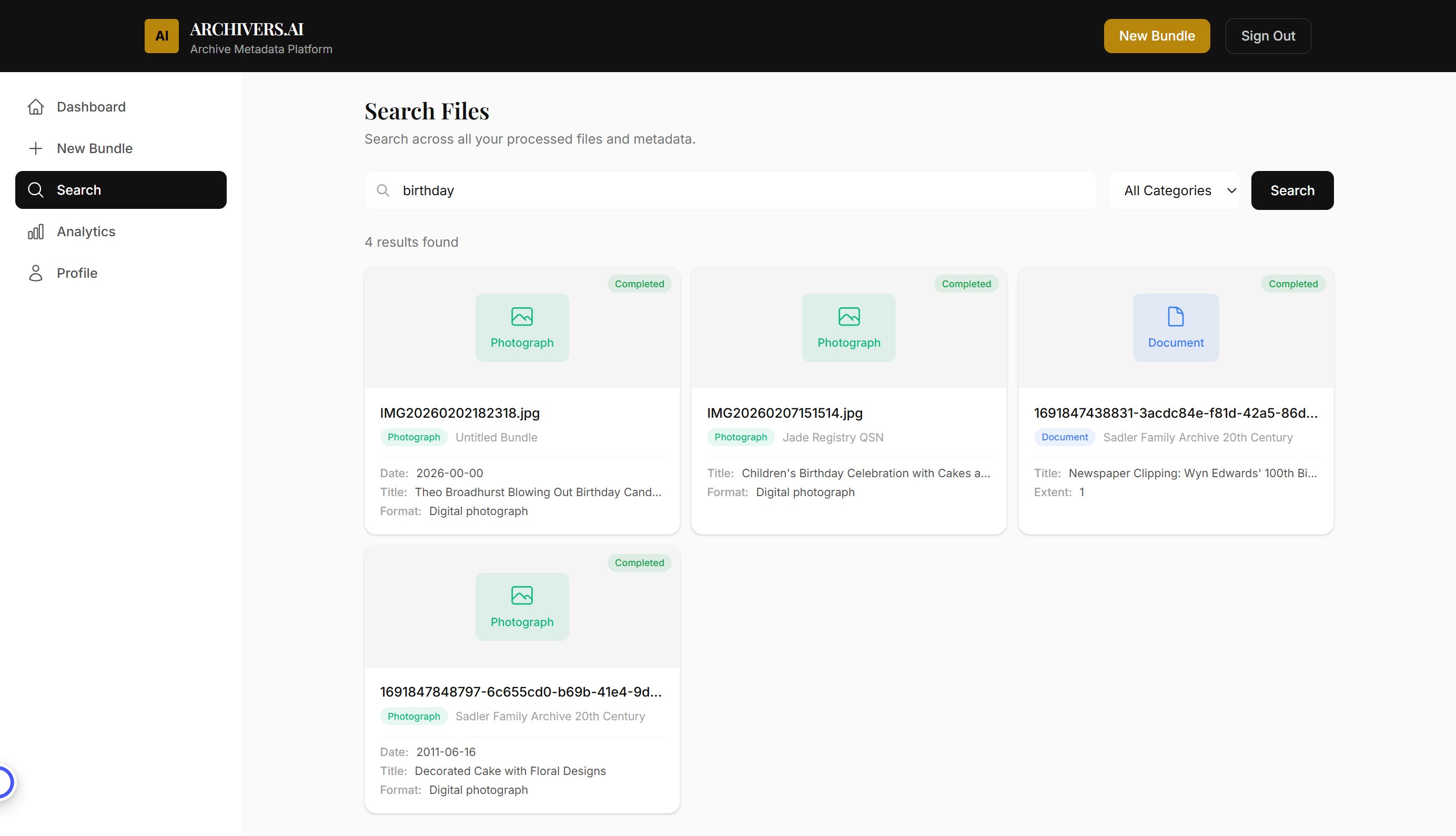
Step 9 — Publication. Select platforms that align with your audience goals. Traditional options include Wikimedia Commons for global reach or Flickr Pro for materials with specific rights restrictions. But discoverability depends on having well-structured, searchable catalogue data — which brings us back to Step 7.
Archivers.ai’s Research & Explore chat interface and search functionality enable public discovery of your catalogued collection. Instead of publishing static pages, you give researchers and community members an interactive way to search, filter, and explore your holdings.
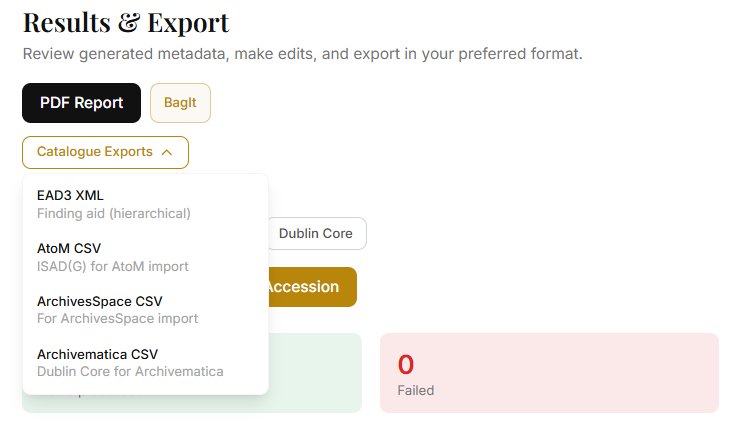
Step 10 — Deposit. Secure the project’s legacy by depositing materials in a recognised repository. This is the NLHF’s long-term preservation requirement in action — your digital assets must outlast the project itself.
Archivers.ai exports in the formats that repositories expect: BagIt packages for digital preservation transfer and EAD3 (Encoded Archival Description) for archival aggregators and finding aid systems. You can also export Dublin Core metadata for web discovery and system CSVs for internal use. Every export is generated directly from the catalogue you have already built — no reformatting, no manual conversion.
Budgeting realistically
Novice managers consistently overlook critical operational costs. A professional budget must account for all of the following:
- Labour — staffing, recruitment, and professional fees
- Volunteer participation — travel, expenses, and support costs to ensure the Inclusion Principle is met
- Equipment — hardware, software subscriptions, and accessibility checking tools
- Expertise and data — software platforms, external consultancy, and training
- Engagement — event costs, publicity, and promotion
- Infrastructure — storage, hosting, and archiving service fees
Archivers.ai fits under the “Software subscriptions” and “Expertise & Data” budget lines. It occupies the middle ground between two common but problematic approaches: expensive outsourced cataloguing services that build no internal capacity, and time-consuming in-house manual work that drains limited staff hours.
| Strategy | Advantages | Disadvantages |
|---|---|---|
| In-house manual | High long-term skill retention; lower contract fees | High training time; intensive volunteer management |
| Outsourced services | Immediate access to high-end expertise; guaranteed standards | High contract costs; no internal capacity building |
| Archivers.ai | Professional-standard output; internal capacity building; scales with collection size | Requires internet access; human review still needed |
Plans include a free tier suitable for small pilots and proof-of-concept work, with paid plans sized for larger projects; every plan and price is published on the pricing page. For a detailed comparison of approaches, see our comparison page.
Sustainability beyond the grant
The NLHF’s Organisational Sustainability principle means your project must demonstrate a viable future beyond the funded period. This is where many applications are weakest — they describe what they will build, but not how they will maintain it.
Three strategies strengthen a sustainability case:
Digitise on demand. Rather than committing to digitise an entire collection upfront, adopt a model where items are processed as requests come in. Institutions can charge service fees for high-quality reproductions, creating a sustainable revenue stream that supports ongoing access. Archivers.ai supports this approach directly — process individual items or small batches through the platform as demand arises, building your catalogue incrementally while generating income.
Low-cost pilots. Smartphones can produce acceptable results for 2D and even basic 3D photogrammetry. Use existing hardware to prove concept before committing to expensive scanners, and include the pilot evidence in your application.
Skills development. The NLHF values projects that leave the organisation more capable than before. Using a platform that builds internal digital skills — rather than outsourcing everything to a contractor — directly supports this investment principle.
The openness mandate
NLHF-funded digital outputs must be shared under an open licence unless a recognised exception applies. This is not optional.
Original content should use Creative Commons Attribution 4.0 (CC BY 4.0) or the Open Government Licence. Metadata, code, and public domain reproductions must use CC0 1.0 — no new rights should be claimed from the reproduction of public domain works. Biological data — any species or habitat records collected — must be shared with the National Biodiversity Network Atlas.
Exceptions exist for sensitive data regarding children or vulnerable adults, culturally sensitive materials (ancestral remains and funerary objects), and oral histories containing special category data. Institutions must implement a “Take Down” policy as standard risk management for any unforeseen ethical or rights issues.
All Archivers.ai exports are designed for open licensing. Dublin Core metadata supports web discovery and aggregation. EAD3 exports feed directly into archival aggregators and national finding aid systems. Metadata is CC0-ready by default, making it straightforward to meet the NLHF’s openness requirements without additional reformatting or rights negotiation.
Evaluation and the long game
Evaluation is a mandatory cost — it is a prerequisite for the final 20 per cent grant payment. But its value extends well beyond compliance. Tracking impact metrics through tools like BaGLAMa (for Wikipedia views) or your own platform analytics provides the hard data required to prove impact.
More importantly, evaluation data forms the institutional business case for future digital preservation budgets. It proves to stakeholders — trustees, local authorities, funding bodies — that your organisation is a capably managed and impactful steward of public heritage.
All project documentation, including financial records and rights permissions, must be retained for at least seven years after project completion to allow for potential government audits.
Where to start
A lifecycle approach to heritage digitisation is not about doing everything at once. It is about making decisions at each stage that support the stages that follow — and that satisfy the funder’s requirements for professionalism, sustainability, and public benefit.
If you are planning a digitisation project and preparing a funding bid, the most effective thing you can do right now is run a small pilot. Process 20 to 50 items from your collection end-to-end, generate your metadata, produce your exports, and include that evidence in your application. It transforms vague intentions into demonstrated capability.
Archivers.ai lets you do exactly that — from accession through AI-assisted cataloguing to archival-standard exports in EAD3 and BagIt. Plans will include a free tier, so there will be no cost barrier to producing the pilot evidence that strengthens your bid.
Visit our heritage funding resource page for further guidance, discuss your NLHF project, or start free with Archivers.ai and build the evidence your funding application needs.