25 March 2026
Budgeting for Digitisation in Your NLHF Bid: A Strategic Guide
Under the National Lottery Heritage Fund’s Heritage 2033 strategy, digitisation has moved from a technical afterthought to a core component of project viability. If your digital plan is not costed properly, your bid will not be funded — regardless of the significance of the collection.
This guide walks through each cost category that NLHF assessors expect to see in a digitisation budget. It explains how to align every line item with the Fund’s four investment principles — Saving Heritage, Protecting the Environment, Inclusion Access and Participation, and Organisational Sustainability — and where to find efficiencies that strengthen your application rather than weaken it.
If you are preparing a heritage digitisation bid at any scale, this article is the budgeting companion you need alongside the NLHF’s own Project Planner.
What the NLHF means by “Digital Outputs”
The NLHF defines Digital Outputs as any asset created with project funding in a digital format designed to provide access to heritage or facilitate engagement and learning. This definition is deliberately broad. It encompasses environmental surveys, 3D models, digitised photographs, transcribed oral histories, and online catalogues.
To secure funding, you must demonstrate how you will transform heritage at risk — materials that are physically degrading or inaccessible — into democratised public assets. Assessors need to see that your budget reflects the full scope of that transformation, not just the cost of a scanner.
Eligible collection types
Your budget should specify which material types you intend to digitise. Common categories include:
- Bound volume collections — registers, guard books, journals, and diaries
- Archive collections — index cards, maps, posters, reports, and correspondence
- Photographic collections — 35mm slides, glass plates, transparencies, and prints
- Film and media — microfilm, microfiche, aperture cards, and audio-visual formats (VHS, Betamax, reel-to-reel)
- Three-dimensional collections — 2D and 3D object photography, virtual reality tours
A note on eligibility
While grants typically target not-for-profit organisations — charities, community archives, local authorities — the NLHF also funds private owners of a heritage asset where the public benefits demonstrably outweigh any private gain. If your organisation falls into this category, your budget must explicitly reflect how digitisation serves the public interest over personal asset appreciation.
Scoping the project before you cost it
The planning phase is the most cost-effective segment of your project lifecycle. Strategic alignment requires a rigorous audit of materials before a single pound is allocated to hardware. Scope creep is the primary driver of budget overruns in heritage digitisation, and the NLHF’s own Project Planner exists to prevent it.
The project vision
Your bid must clearly articulate:
- The idea — a concise description of the project’s motivation and intended legacy
- The materials — an audit of specific collections and the rationale for their selection
- The team — broken down into internal staff (and their digital skills), external recruits or consultants, and community volunteers with their management requirements
- Audiences and users — local community groups and residents, specialist researchers and educators, and global users reaching the collection via open platforms
The process
Before costing begins, you need documented answers to three questions:
- Permissions — have you identified rights holders and cleared permissions for open licensing?
- Data management — which metadata standards will you use, which file formats, and where will data be stored?
- Publication — which platforms will host the heritage for public access?
A copyright audit during scoping is particularly valuable. Identifying items with unknown copyright status early allows you to pivot your workflow toward public domain materials, preventing the legal costs and project delays that frequently derail the delivery phase.
Categorising digitisation costs: beyond the scanner
The NLHF mandates “proportionate costs.” A common strategic failure is budgeting for hardware while ignoring the labour required for data curation and metadata enrichment. Assessors will notice this imbalance immediately.
Labour
This covers recruitment, salaries, volunteer expenses, and project management. Investing in staff training supports the Organisational Sustainability principle — upskilling your team reduces long-term reliance on external consultants and builds a lasting capability within your organisation.
Equipment
Professional scanners, LiDAR sensors, camera equipment, tripods, and lighting. High-specification equipment ensures archival-grade capture of fragile materials, directly supporting the Saving Heritage principle. Budget for maintenance and calibration as well as purchase.
HTR, OCR, transcription, and data entry
This is the category that catches most applicants off guard. Scanning a document is only the first step — the resulting image is useless to researchers unless the text is machine-readable, searchable, and described with proper metadata.
Handwritten Text Recognition (HTR) and Optical Character Recognition (OCR) convert scanned pages into searchable text. Audio and video transcription does the same for oral histories, interviews, and film. Manual data entry fills the gaps where automated tools cannot reach.
Historically, these costs were substantial — either in staff time for manual transcription or in fees paid to specialist bureaux. Today, AI-powered platforms can handle much of this work at a fraction of the cost. Archivers.ai combines OCR, handwritten text recognition, audio and video transcription, and AI metadata enrichment in a single platform. It processes documents, photographs, artefacts, audio, and video — the full range of material types you are likely to encounter in a heritage digitisation project. With a Professional plan starting at around £24 per month on an annual subscription, it is straightforward to include as a budget line item under “Software subscriptions” rather than commissioning separate services for each task.
This directly supports the Inclusion principle: making handwritten or audio records searchable opens them to users with accessibility needs and to researchers who would otherwise never encounter the material.
Engagement
Publicity, promotion, event travel, and workshop venue hire. This is a mandatory outcome area — you must evidence the NLHF requirement of involving a wider range of people in heritage. Budget for it explicitly.
The three mandatory pillars: availability, accessibility, and openness
The NLHF enforces strict conditions on digital outputs. You must budget for all three pillars to avoid a breach of grant terms. These are not optional enhancements — they are contractual obligations.
Pillar 1: Availability
Your outputs must remain accessible to the public for a specified duration based on your award size:
| Grant size | Required years of public access |
|---|---|
| £10,000 – £250,000 | 5 years |
| Over £250,000 | 20 years |
Factor ongoing hosting, domain renewal, and platform maintenance into your budget for the full duration. If your organisation cannot afford to self-host for 20 years, budget for depositing materials in established aggregators such as Europeana or Art UK.
Pillar 2: Accessibility
You must adhere to recognised standards to ensure inclusive participation:
- Grants £10k–£250k — must meet at least W3C Single A (WCAG 2.1 Level A) standards
- Grants over £250k — must meet at least W3C Double A (WCAG 2.1 Level AA) standards
Include costs for accessibility checking services or tools in your budget. This is not merely a compliance exercise — it determines whether users with visual impairments, motor disabilities, or cognitive differences can actually use your digitised collection. Our guide to meeting NLHF digital good practice with AI covers how to demonstrate accessibility compliance in your bid.
A practical route to meeting these standards is ensuring that all digitised text is machine-readable and screen-reader compatible from the outset. Archivers.ai’s OCR and transcription capabilities produce machine-readable text output for documents and searchable transcripts for audio and video recordings. When your digitised materials are already structured as searchable text rather than flat images, you have a solid foundation for WCAG compliance without needing to retrofit accessibility after the fact.
Pillar 3: Openness
The NLHF requires that heritage resources be shared under Open Licences to democratise access:
- Original content — must use CC BY 4.0 (Attribution)
- Metadata, data, and code — must use CC0 1.0 (Public Domain Dedication)
- Biological data — species and habitat records must be shared with the National Biodiversity Network Atlas or Local Environmental Records Centre
- Exceptions — depictions of under-18s, adults at risk, or sensitive cultural materials such as funerary objects
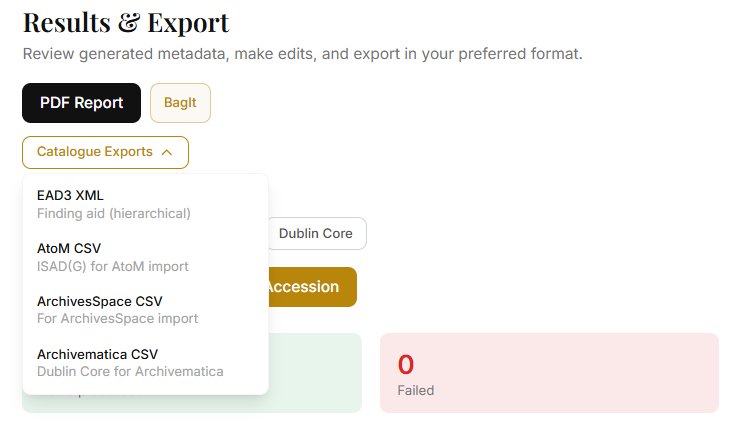
The CC0 requirement for metadata is particularly important for your software budget. Any cataloguing platform you use must be capable of exporting metadata in open, standards-compliant formats that can be shared freely. Archivers.ai’s Dublin Core export is specifically designed for open data sharing — metadata generated in the platform can be exported under CC0 1.0 as required. The platform also exports to EAD3 XML, AtoM CSV, ArchivesSpace CSV, and Archivematica CSV, giving you the flexibility to deposit records in whichever repository your project requires.
Using CC BY 4.0 for original content is a competitive advantage in your bid. It demonstrates to assessors that you are not just saving heritage but democratising it — directly fulfilling the Inclusion principle by allowing global reuse on platforms like Wikimedia Commons.
Budgeting for metadata and data management
Metadata is the layer that makes your digitised collection discoverable, citable, and interoperable with other archives. Without it, you have a folder of images. With it, you have a searchable public resource.
What to budget for
- Archival master files — storage for uncompressed files (TIFF for images, WAV for audio)
- Access files — storage for compressed versions for public use (JPEG, MP3)
- Metadata curation — the costs of creating, maintaining, and quality-checking the catalogue records that make each item findable. For a detailed look at how ISAD(G), EAD3, and Dublin Core interact, see our guide to NLHF metadata standards
- Metadata standards compliance — ensuring your descriptions conform to professional archival standards such as ISAD(G), Dublin Core, or SPECTRUM
The metadata curation line is where many bids underestimate costs. Describing thousands of items to a professional standard is labour-intensive work — traditionally requiring either dedicated cataloguing staff or external metadata consultancy.
This is where AI metadata enrichment changes the economics of a heritage digitisation project. Archivers.ai generates ISAD(G)-compliant metadata automatically, analysing each item and producing structured catalogue records with fields for title, date, scope and content, creator, and physical description. The platform’s exports to EAD3 XML, Dublin Core, AtoM CSV, ArchivesSpace CSV, and Archivematica CSV mean you can feed records directly into your chosen repository system without manual reformatting. For many projects, this eliminates the need for a separate metadata consultancy budget line entirely — or at minimum reduces it to a quality-assurance review rather than a full cataloguing commission.
Storage and long-term sustainability
Digital stewardship is founded on the 3-2-1 rule: keep three copies of data, on two different media types, with one backup stored offsite. This is the baseline for preservation, and your budget must reflect it. For a deeper dive into storage options and costs, see our guide to digital archive backup and storage.
Storage cost categories
Your budget should include:
- Local storage — hard drives or NAS devices for your primary working copies
- Cloud storage — subscriptions for offsite backup (Amazon S3 Glacier, Microsoft Azure, or equivalent)
- Repository deposit — costs for packaging and ingesting materials into a long-term digital preservation repository
When budgeting for repository deposit, consider how your materials will be packaged. The BagIt specification is the sector standard for creating self-describing containers of digital content, and preservation repositories expect to receive materials in this format. Archivers.ai’s BagIt export includes PREMIS preservation metadata — the standard vocabulary for recording the provenance, rights, and technical characteristics of digital objects — creating standards-ready packages that can be ingested directly into long-term repositories. This saves considerable time compared to manually assembling BagIt packages and writing PREMIS records from scratch.
Sustainability strategy
If your organisation cannot afford the 20-year hosting costs for a bespoke platform, budget for depositing materials in established aggregators like Europeana or Art UK. This ensures long-term survival without the overhead of self-hosting.
The NLHF also looks favourably on the “Digitise on Demand” model. By providing low-resolution access for free and charging a small service fee for high-resolution requests of undigitised items, you create an income stream to fund new digitisation after the grant expires. Include this in your sustainability narrative.
In-house digitisation versus outsourcing
This is one of the most consequential decisions in your budget. Each approach aligns with different NLHF investment principles, and assessors will want to see that you have weighed the trade-offs deliberately.
In-house digitisation builds internal resilience — the Organisational Sustainability principle. Your staff and volunteers develop lasting skills in digital imaging, metadata creation, and preservation workflows. The long-term cost of equipment depreciation and maintenance is offset by the capability you retain after the grant ends. For community archives and volunteer-led organisations, this approach also strengthens the Inclusion principle by involving a wider range of people directly in heritage work.
Outsourcing to specialist suppliers guarantees professional technical standards — the Saving Heritage principle. Expert bureaux bring calibrated equipment, controlled environments, and established quality-assurance processes. For fragile or high-value materials, this may be the only responsible option.
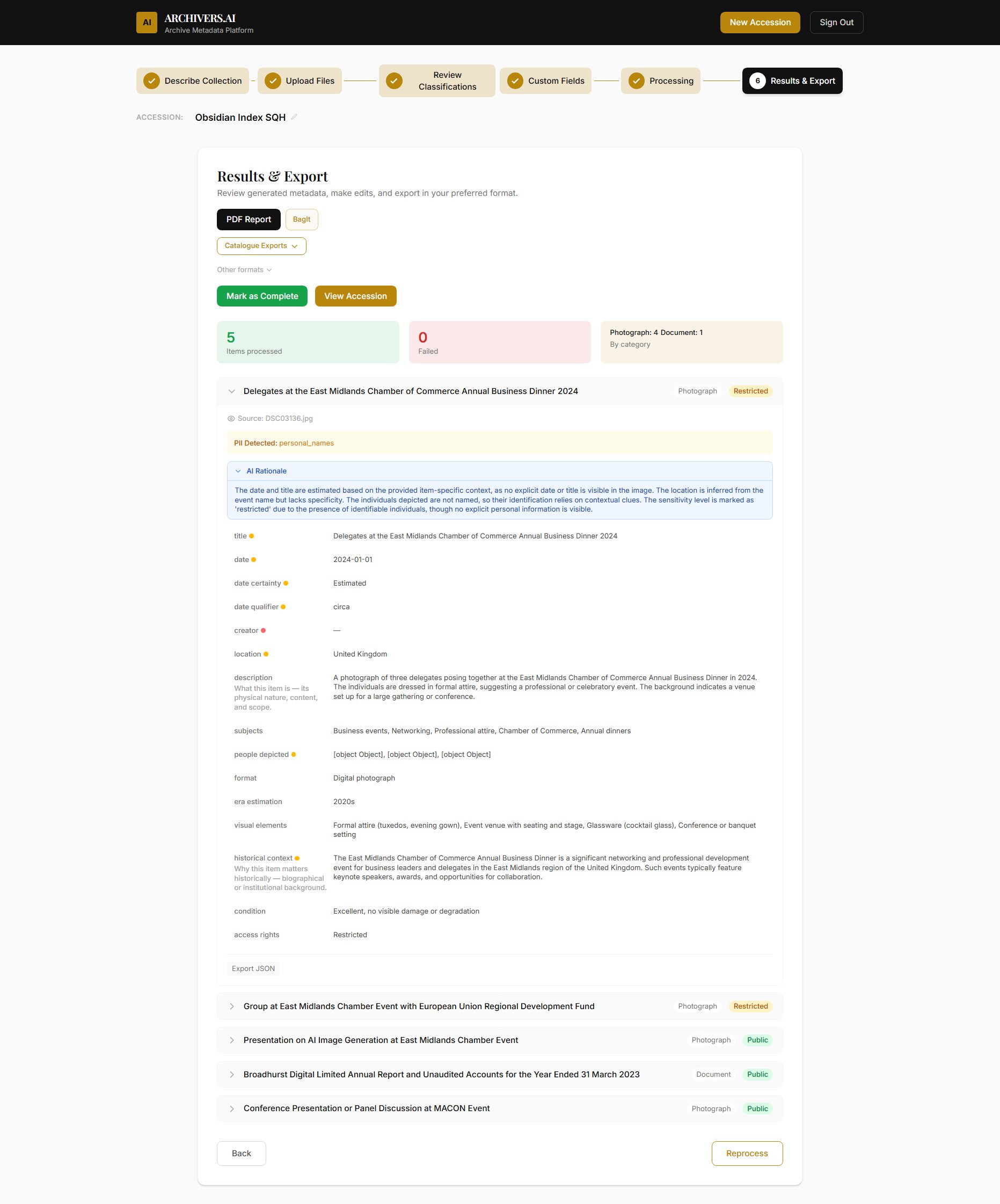
The practical middle ground is to handle digitisation in-house while using AI-powered tools for the metadata enrichment that would otherwise require specialist consultancy. A platform like Archivers.ai gives your team professional-grade AI cataloguing — automatic field population, confidence indicators for each generated value, and standards-compliant exports — without the cost of bringing in an external metadata consultant. Your staff learn to review and refine AI-generated descriptions, building genuine cataloguing skills while working at a pace that manual methods cannot match.
This hybrid approach is particularly strong in an NLHF bid because it serves both the Sustainability and Saving Heritage principles simultaneously. You build internal capability and maintain professional standards. For museum directors and heads of collections balancing limited budgets against large backlogs, it is often the most realistic path to a fundable bid.
Financial safeguards: contingency, audit, and evaluation
A fundable bid demonstrates resilience through a well-funded risk register. Assessors will look for the following:
- The seven-year rule — you must budget for the retention of project paperwork and financial records, as the government or NLHF can audit your project up to seven years after it ends. Ensure your data storage budget accounts for this administrative longevity.
- Contingency — a mandatory line item of 5–10% is expected. In the current economic climate, this is vital for managing fluctuating equipment or consultant costs. Do not treat contingency as a pool of unallocated money — map it to specific risks in your risk register.
- Evaluation — this is a requirement, not a nice-to-have. Budget for either professional fees for an external evaluator or dedicated staff time to gather impact data throughout the project lifecycle.
- Non-cash contributions — reflect volunteer time and donated venue hire to improve your Value for Money score. The NLHF’s guidance provides rates for calculating volunteer contributions.
Final checklist for a fundable digital bid
To bring this together, here is a practical checklist to review before you submit:
-
Consult your NLHF regional team early. Align your project with regional priority areas and draw on their expertise. They are guardians of the public purse and want your project to succeed. If you are looking for tailored support, our heritage funding page explains how Archivers.ai works with NLHF-funded projects.
-
Anchor every budget line to an investment principle. Every cost should demonstrably support Saving Heritage, Protecting the Environment, Inclusion, or Organisational Sustainability. If a line item does not connect to a principle, question whether it belongs.
-
Cost your metadata properly. Do not assume cataloguing is a trivial add-on to scanning. It is typically the largest single cost in a digitisation project after staff salaries. Budget realistically for the volume of items you intend to describe.
-
Include an AI metadata platform in your software budget. A tool like Archivers.ai reduces manual cataloguing costs while meeting NLHF metadata and accessibility standards — OCR, transcription, ISAD(G)-compliant descriptions, and open-format exports in a single subscription. At ~£24/month, it is a defensible line item that demonstrably improves value for money.
-
Use the Project Planner. Do not rush. Submit when your vision is firm and your technical workflows — OCR, HTR, transcription, metadata standards — are fully costed and documented.
-
Plan for openness from day one. Budget for CC BY 4.0 licensing of content and CC0 1.0 for metadata. Choose tools that export in open, standards-compliant formats so you are not locked into a single platform.
-
Budget for accessibility testing. WCAG compliance is a contractual obligation, not a stretch goal. Include it as a line item.
-
Apply the 3-2-1 rule to your storage budget. Three copies, two media types, one offsite. If you cannot fund 20-year self-hosting, budget for deposit in an established aggregator.
-
If delivering in Wales, budget for bilingual outputs. Plan and cost Welsh language provision across all aspects of your digital work.
-
Write clearly and avoid jargon. Describe your heritage in factual terms — its condition, scale, and significance. Assessors read dozens of applications; clarity and precision stand out.
Proper budgeting today ensures that the heritage we value remains resilient and accessible for future generations. That is the ultimate mission of the National Lottery Heritage Fund — and a well-structured digital budget is how you prove your project deserves to be part of it.
Ready to see how AI metadata enrichment works in practice? Discuss your NLHF project with us or try Archivers.ai free — upload a document, photograph, or audio file and see ISAD(G)-compliant catalogue records generated in minutes. No credit card required.
Try The Archiver on your collection
Request early access and see what AI cataloguing can do for your collection.
Request early access