Measurable impact. Clear ROI.

The Archiver turns your cataloguing backlog from a liability into a strategic asset. Faster, cheaper, and funder-ready — with a clear business case for your board.

10×

faster to draft metadata than manual description, typically

EAD3

export from day one

20

items free to validate the approach

Track backlog reduction in real time

Every accession processed through The Archiver produces a clear record: items catalogued, metadata generated, exports delivered. Your team can demonstrate progress to the board with concrete numbers, not estimates.

The analysis view summarises themes, arrangement suggestions, and gaps across each accession — giving you oversight without micromanagement.
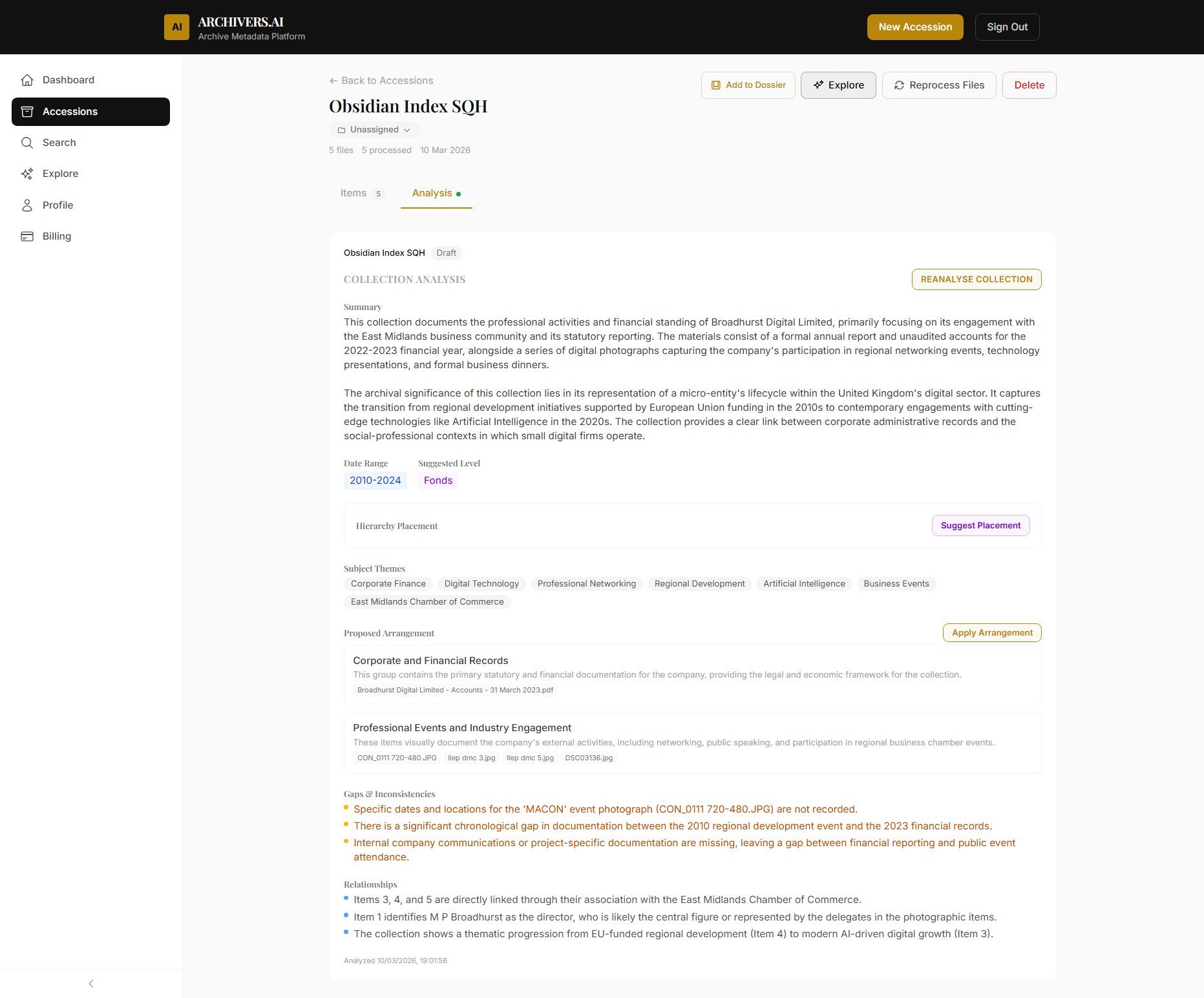
The Archiver's analysis view showing themes, arrangement suggestions and completeness metrics for a catalogued accession

The cost of the alternative

A cataloguing backlog isn't just an operational inconvenience. It's a financial risk. AI-assisted cataloguing reduces the time to produce draft records — but professional review remains essential for every item that enters your catalogue.

A skilled archivist can catalogue around 10–20 items per day when working carefully to a recognised standard. For a collection backlog of 5,000 items, that represents a minimum of 250 working days — more than a full year of staff time, before any other duties.

At a salary cost of £35,000–£45,000 per year for a qualified archivist, clearing a backlog of that size represents £35k–£45k in staff costs alone. For larger backlogs, multiply accordingly.

The Archiver generates draft descriptions for the same volume in days rather than months — with AI handling the initial metadata and your team reviewing and approving every record. The staff time saved goes back into your service, your public programmes, and your next funding application.

Meeting funder expectations automatically

The National Lottery Heritage Fund increasingly expects EAD-compliant outputs as evidence of proper stewardship of publicly funded collections. Other major funders have similar requirements.

The Archiver produces EAD3 and BagIt outputs as standard — no additional work, no specialist software, no consultant fees. Every catalogued item is automatically funder-ready.

NLHF expects EAD-compliant outputs

The Archiver produces EAD3 and BagIt exports automatically — for every item you catalogue. No additional software, no consultant fees.

The case for your board

  • Reduces backlog risk. Uncatalogued collections are an audit risk and a reputational liability. The Archiver turns backlogs into catalogued, searchable archives.
  • Demonstrates stewardship. Standards-compliant cataloguing demonstrates proper care of your collection to funders, accreditation bodies, and the public.
  • Funder-ready outputs. EAD3 and BagIt exports, accepted by NLHF and other major grant programmes, generated automatically.
  • No new IT infrastructure. The Archiver runs in a web browser. No servers, no software licences, no implementation project.
  • Scales with the collection. From 20 items to 200,000 — the same tool, the same workflow, the same standards.
  • Measurable output. Track items catalogued, time saved, and backlog cleared — clear metrics for board reporting.

Further reading

Updates from The Archiver